Showing posts with label online safety. Show all posts

Wednesday, 1 June 2011

Ensuring your information is safe online

The Internet has been an amazing force for good in the world—opening up communications, boosting economic growth and promoting free expression. But like all technologies, it can also be used for bad things. Today, despite the efforts of Internet companies and the security community, identity theft, fraud and the hijacking of people’s email accounts are common problems online.

Bad actors take advantage of the fact that most people aren’t that tech savvy—hijacking accounts by using malware and phishing scams that trick users into sharing their passwords, or by using passwords obtained by hacking other websites. Most account hijackings are not very targeted; they are designed to steal identities, acquire financial data or send spam. But some attacks are targeted at specific individuals.

Through the strength of our cloud-based security and abuse detection systems*, we recently uncovered a campaign to collect user passwords, likely through phishing. This campaign, which appears to originate from Jinan, China, affected what seem to be the personal Gmail accounts of hundreds of users including, among others, senior U.S. government officials, Chinese political activists, officials in several Asian countries (predominantly South Korea), military personnel and journalists.

The goal of this effort seems to have been to monitor the contents of these users’ emails, with the perpetrators apparently using stolen passwords to change peoples’ forwarding and delegation settings. (Gmail enables you to forward your emails automatically, as well as grant others access to your account.)

Google detected and has disrupted this campaign to take users’ passwords and monitor their emails. We have notified victims and secured their accounts. In addition, we have notified relevant government authorities.

It’s important to stress that our internal systems have not been affected—these account hijackings were not the result of a security problem with Gmail itself. But we believe that being open about these security issues helps users better protect their information online.

Here are some ways to improve your security when using Google products:
  • Enable 2-step verification. This Gmail feature uses a phone and second password on sign-in, and it protected some accounts from this attack. So check out this video on setting up 2-step verification.
Fig. 1

 Fig. 2
Please spend ten minutes today taking steps to improve your online security so that you can experience all that the Internet offers—while also protecting your data.

*We also relied on user reports and this external report to uncover the campaign described.

Thursday, 9 September 2010

Announcing our new Family Safety Center

(Cross-posted to the Google Public Policy Blog)

Helping your children use the Internet safely is similar to teaching them to navigate the offline world. There are parts of the real world that you wouldn’t let your children explore unsupervised—and that goes for the online world as well. But while most of us remember being taught to cross the road and not talk to strangers, we probably weren’t taught how much personal information we should share online or how to handle cyberbullies.

Therefore, it’s no surprise when parents and teachers tell us they want to learn more about how to help their kids use the Internet safely and responsibly.

Today, we’re launching our new Family Safety Center; a one-stop shop about staying safe online. We’ve included advice from leading child safety organizations around the world, tips and ideas from parents here at Google, as well as information on how to use the safety tools and controls built into Google products.

For day-to-day practical tips we asked some of our parents at Google to share their own ideas. Tactics they use range from limiting screen time and preventing computers in kids’ bedrooms to ad hoc checks on their browser history and social networking profiles. Everyone has different ideas and there’s no right or wrong answer, but hopefully some of these will resonate and inspire you. See more videos and let us know your own thoughts on our YouTube channel.


To answer some of the toughest questions most important to parents, such as accessing inappropriate content and meeting strangers online, we went straight to the people that know best; the organizations that advocate and promote child safety and digital literacy. Organizations that we’ve partnered with around the world include the U.S. Federal Trade Commission’s OnGuard Online initiative, the Canadian Centre for Child Protection, the Australian Communications and Media Authority, U.K.’s ChildNet, and New Zealand’s NetSafe.

The new Safety Center also provides information on the safety tools built into Google products. SafeSearch and YouTube Safety Mode can help you control what content your children stumble across. Sharing controls in YouTube, Picasa, Blogger and others ensure your videos, photos and blogs are shared only with the right people. And in response to popular requests, we’ve added a section on managing geolocation features on mobiles.

With kids growing up in an age where digital know-how is essential, it’s increasingly important to ensure that they’re developing healthy, safe and responsible online habits. And we’re thinking every day about how we can help parents and teachers to do just that.

Friday, 11 June 2010

Blazing the online safety trail

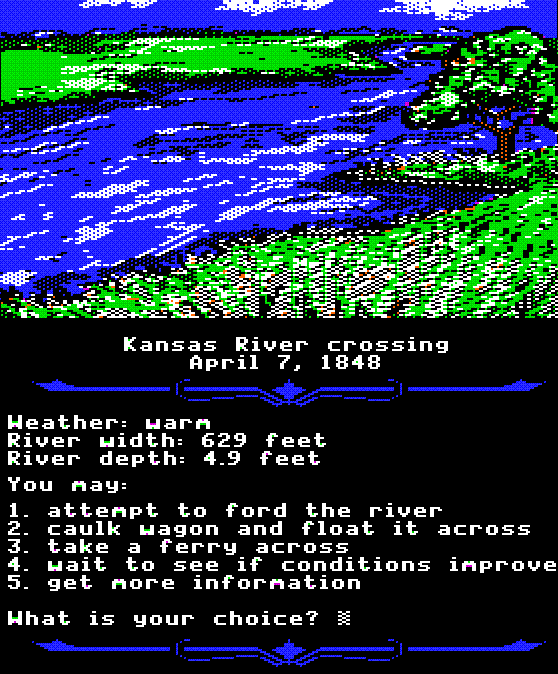
When I was in middle school, computer class was spent learning the basics of “keyboarding” and rushing to finish the lesson so I could get back to my journey on the Oregon Trail. My main goal was to survive the river crossings, maintain enough buffalo meat to sustain my family and arrive safely in California with my entire fake family still alive.

Today, many schools are teaching their first graders the basic computer skills I was learning at 13. Teens have always been the quickest adopters of new technology, as parents and teachers struggle to keep up and equip teens to make good decisions online.

When I visited Dunne Technology Academy in South Chicago earlier this week, most of the students were getting ready for their summer break, but we paused for a bit to talk about what they’re doing online. The majority of these tech-savvy teens had all encountered cyberbullying at some point, had seen pictures and information on profiles they thought were inappropriate, and had had someone try to trick them through a phishing scam.

We spent the day discussing ways to avoid being scammed, how to create an online profile that can be an asset rather than a liability, and actions you can take if you’re being bullied, harassed or see inappropriate content. Most students seemed to understand that their online identity and their “real world” self were one and the same, and that they have choices in managing their content and reputation online. We agreed that by applying the rules of good citizenship online, the Internet would be a safer and more enjoyable experience for everyone.

So while teens have more difficult choices online today than to ford or to ferry the river in Oregon Trail, we can prepare them to make smart decisions online. Check out the educational materials from our Digital Literacy Tour in our Google For Educators site at www.google.com/educators/digitalliteracy.html.


Wednesday, 11 November 2009

Locking SafeSearch

When you're searching on Google, we think you should have the choice to keep adult content out of your search results. That's why we developed SafeSearch, a feature that lets you filter sexually explicit web sites and images from your search results. While no filter is 100% accurate, SafeSearch helps you avoid content you may prefer not to see or would rather your children did not stumble across. We think it works pretty well, but we're always looking for ways to improve the feature.

Today we're launching a feature that lets you lock your SafeSearch setting to the Strict level of filtering. When you lock SafeSearch, two things will change. First, you'll need to enter your password to change the setting. Second, the Google search results page will be visibly different to indicate that SafeSearch is locked:


Even from across the room, the colored balls give parents and teachers a clear visual cue that SafeSearch is still locked. And if you don't see them, it's quick and easy to verify and re-lock SafeSearch.

To use SafeSearch lock, go to the "Search Settings" page on Google. For detailed instructions, check out this video.


We hope you and your family find exactly what you’re looking for in Google search results — and nothing more.

Friday, 4 September 2009

Helping create responsible digital citizens

With more and more kids going online, whether to connect over social networking sites, mingle in chat rooms or play games, it's become increasingly important for families, schools and service providers to work together to ensure that the younger generation understands their responsibilities while they explore the virtual world.

A few weeks ago, Google participated in the 21st Annual Crimes Against Children Conference in Dallas, where over 3,500 members of law enforcement, child advocacy groups, the tech industry and the National Center for Missing and Exploited Children (NCMEC) convened to share ideas, discuss strategies and explore new technologies designed to combat the many and varied forms of crimes against children. We had the opportunity to describe some of the positive steps Google is taking to educate and safeguard minors who use our products and services, as well as the unique ways we support the individuals on our staff who do child exploitation-related work.

According to a recent NCMEC study in patterns and trends in online child victimization, the past few years have seen a 6% increase in reports of kids providing images and videos of themselves when asked by online acquaintances; sending naked photos of themselves through text messages ("sexting"); and cyber-bullying. This new trend underscores the need to educate our younger users, their families and teachers on ways to create and enjoy safe online experiences.

We're doing our part by working with child safety organizations and law enforcement around the globe to spread positive messages about life online. For example, in mid-September, we're launching a global training program on YouTube to help teens teach other teens about these issues. This is just one step among many that we're taking to help create a generation of responsible digital citizens.

Thursday, 11 December 2008

Safety, education, and empowerment on YouTube

(Cross-posted from the YouTube Blog)

We've always been committed to providing you the tools to have the best possible YouTube experience. Educating parents, teens, and families on how to stay safe on our site is a critical part of that commitment, so we can't think of a more appropriate place to introduce our new Abuse and Safety Center than at the Family Online Safety Institute (FOSI) conference in Washington, D.C., today.


The center features straightforward safety tips and multimedia resources from experts and prominent safety organizations. We are empowering people with the information and tools they need to help them deal with issues like cyberbullying, online harassment, and hateful content.


The new center also makes it easier for you to find our Help and Safety Tool, which lets you report concerns to us and gives you granular control over your channel, like the option of blocking comments from specific users or disabling the video comments feature on specific videos.

The Abuse and Safety Center is easy to find. Just look at the bottom of any YouTube page and click on the link titled "Abuse and Safety Center." From phishing scams to just learning what it means to be a good YouTube citizen, you'll find the information you need.

Finally, check out FOSI's meeting page for more information about our presence at the conference, where Shantal Rands from Google's legal team will receive a FOSI Award for Outstanding Achievement in advancing the goal of a safer Internet. Plus, Andrew McLaughlin, Google's Director of Global Policy & Government Affairs, is speaking about "Protecting Kids and Free Speech Online," and YouTube's Policy Analyst Micah Schaffer will address online safety in social media.

We'll continue to add new information and features to the center, so check back often.

Wednesday, 24 September 2008

Online safety tips from Google and AARP

Now more than ever before, older Americans are logging on and surfing the web to stay in touch with family and friends, read websites and blogs, share photos, watch videos, and run online businesses. Like all Internet users, they're sometimes faced with unsafe activity online, such as viruses and malware, and they're looking for resources to learn how to keep their information on the web safe, private, and under their control.

So we teamed up with AARP to launch a new video series that provides AARP members with helpful, easy-to-understand tips on how to stay safe online. It includes pointers on how to set privacy controls in online photo-sharing sites, configure firewalls to protect your computer, select safe and secure passwords for your online accounts, shop safely online, and avoid phishing scams. You can find the videos on AARP's online safety page, as well as on our Privacy Channel on YouTube.

Here's a look at the first video, Safe Starts:


Our team gave a sneak peek of the videos from our booth at the annual AARP member event, Life@50+, earlier this month. We received lots of great feedback from AARP members. Even the most computer-savvy members found the videos helpful, and most folks who stopped by were eager to share them with friends and family members who are just getting started online.

Check out the rest of the online safety video series. We hope the tips in these videos raise awareness among Internet users of all ages about how to stay safe online.

Update (12:06 p.m.): Nancy LeaMonde, AARP's Executive VP of Social Impact, just posted tips from the video series on AARP's blog.

Tuesday, 24 June 2008

Keeping kids safe in a digital world


In the spirit of National Internet Safety Month, we welcomed Ernie Allen, co-founder and president of the National Center for Missing and Exploited Children (NCMEC) to the Googleplex last week to discuss child protection issues.

For those not familiar with it, NCMEC works closely with federal law enforcement across the U.S. to help prevent child abduction and sexual exploitation and to help find missing children. From serving as the clearinghouse for reports of online child pornography to issuing Amber Alerts when children go missing to reuniting families in the wake of Katrina, NCMEC is at the forefront of efforts to protect society's most vulnerable members.

In a policy talk called "Beyond Milk Cartons: Keeping kids safe in a digital world", Ernie provided an overview of NCMEC's work and chatted with Googlers about the ever-changing landscape of child protection challenges shared by parents, educators, advocacy organizations, and technology companies like Google as we work to help families make smart choices online. Watch Ernie's talk on YouTube.

Technology is an invaluable tool for addressing some of these challenges. In a recent example, a team of Google engineers dedicated their 20 percent time over the last year and a half to build cutting-edge software for NCMEC that uses image and video recognition technology to help NCMEC analysts more effectively sort and review incoming reports of child exploitation. NCMEC analysts sort through tens of millions of images in child sexual abuse investigations, and we've tried to leverage our expertise in organizing huge amounts of data to help make their important work more automated and efficient.

When it comes to keeping kids safe on the Internet, we believe that education for families, support for law enforcement, and empowering technology tools, like our SafeSearch filter and the NCMEC software, are all critical pieces of the puzzle.

Tackling online child safety issues is no small task, but we'll continue our collaboration with organizations like NCMEC, along with other partners in schools, government and industry, to take collective strides in the right direction.

Monday, 14 April 2008

Building software tools to find child victims


Since it was founded in 1984, the National Center for Missing & Exploited Children (NCMEC) has reported more than 570,000 child exploitation leads to law enforcement agencies and assisted with more than 140,900 missing child cases, resulting in the recovery of more than 124,500 children.

The advent of the Internet has unfortunately provided child predators with a new avenue to exploit children. In August 2006, we joined NCMEC's Technology Coalition Against Child Pornography, teaming up with other tech industry companies to develop solutions that hinder predators' ability to use the Internet to exploit children or traffic in child pornography.

In an outshoot of that industry initiative, I discovered some other areas where I thought Google could help the staff at NCMEC. For instance, to date, NCMEC analysts have reviewed more than 13 million child pornography images and videos to assist law enforcement agencies working to identify and rescue children. This task has been time-consuming, and NCMEC analysts were simply getting overwhelmed by all of the data they had to sift through.

One of our core strengths here at Google is our ability to manage and organize immense amounts of information -- whether it's text, image, audio, or video -- and make it more useful and accessible for users. As a member of Google's research group, I realized that NCMEC had an immediate need for some of our research-stage technology. They needed help organizing and making sense of the enormous number of images and videos sent to them every week through their CyberTipline and from law enforcement officers nationwide.

So we went into overdrive. I recruited some fellow engineers to help me build tools that NCMEC might find useful. Throughout 2007, using our 20% time, we created innovative software tools to help NCMEC track down child predators through video and image search. With these tools, analysts will be able to more quickly and easily search NCMEC's large information systems to sort and identify files that contain images of child pornography. In addition, a new video tool we built streamlines analysts' review of video snippets.

The keys here were organization, scalability, and search. In particular, the tools we provided will aid in organizing and indexing NCMEC's information so that analysts can both deal with new images and videos more efficiently and also reference historical material more effectively. We hope the tools we've built for NCMEC will help its analysts make the important and often time-sensitive work of investigating child predators faster and more efficient.

For me, working with NCMEC provided an incredible opportunity. It allowed us to immediately deploy some of our latest research in image and video analysis in a real-world setting. On a personal note, I've been truly inspired by the entire NCMEC team's dedication and diligence in completing such a heart-wrenching mission.

You always hope that your work will eventually be used do some good in the world, and this was an amazing chance to make that hope real by creating tools that have the potential to aid investigations of child predators, find child victims and reduce the flow of child pornography on the Internet.

Tuesday, 25 March 2008

A common sense approach to Internet safety


Over the years, we've built tools and offered resources to help kids and families stay safe online. Our SafeSearch feature, for example, helps filter explicit content from search results.

We've also been involved in a variety of local initiatives to educate families about how to stay safe while surfing the web. Here are a few highlights:
  • Google India initiated "Be NetSmart," an Internet safety campaign created in cooperation with local law enforcement authorities that aims to educate students, parents, and teachers across the country about the great value the Internet can bring to their lives, while also teaching best practices for safe surfing.
  • And Google Germany worked with the national government, industry representatives, and a number of local organizations recently to launch a search engine for children.
As part of these ongoing efforts to provide online safety resources for parents and kids, we've created Tips for Online Safety, a site designed to help families find quick links to safety tools like SafeSearch, as well as new resources, like a video offering online safety pointers that we've developed in partnership with Common Sense Media. In the video, Anne Zehren, president of Common Sense, offers easy-to-implement tips, like how to set privacy and sharing controls on social networking sites and the importance of having reasonable rules for Internet use at home with appropriate levels of supervision.

Users can also download our new Online Family Safety Guide (PDF), which includes useful Internet Safety pointers for parents, or check out a quick tutorial on SafeSearch created by one of our partner organizations, GetNetWise.

We all have roles to play in keeping kids safe online. Parents need to be involved with their kids' online lives and teach them how to make smart decisions. And Internet companies like Google need to continue to empower parents and kids with tools and resources that help put them in control of their online experiences and make web surfing safer.

Friday, 7 December 2007

Google's (and parents') role in keeping kids safe online


We know that technologies like the "v-chip" can be used to keep kids from seeing inappropriate content on TV. And while technology has an important role to play in protecting kids online, it's as important that parents implant a symbolic "v-chip" in their children's minds to guide them when it comes to deciding what online content is and is not appropriate.

That was one of the observations I shared this week at the Family Online Safety Institute's conference in Washington, D.C. The Internet provides an amazing opportunity for young people to express themselves creatively and access immense quantities of useful information. Kids are using geospatial, mobile and social networking technologies, for example, to learn in new, interactive ways. The Internet also provides unparalleled opportunities for free expression, enabling kids and adults alike to deliver tremendous benefit to society by voicing sometimes unpopular, inconvenient, or controversial opinions.

At the same time, there is some online content and activity that is unsuitable for younger users. Google is dedicated to supporting parents' efforts to educate and protect their children when they go online. We've invested in developing family safety tools that empower parents to limit what online content their children can discover. Our SafeSearch filter, which users can adjust to block explicit content from their search results, is an example of this type of technology.

On YouTube, where we host user-generated content, we aim to offer a community for free expression that is suitable for children and protects them from exploitation. Our work to keep YouTube safe for children includes clear policies about what is and is not acceptable on the site; robust mechanisms to enforce these policies, such as easy tools for users to police the content by flagging inappropriate videos; innovative product features that enable safe behavior; and YouTube safety tips.

We've also partnered with child safety organizations, including CommonSense Media, i-Safe, iKeepSafe, NetFamilyNews, and, of course, the Family Online Safety Institute to increase awareness about online child safety. In addition, we cooperate with law enforcement and industry partners to combat child exploitation and help minimize the uploading of illegal content, offering training and technical assistance to law enforcement officials and providing groups like the National Center For Missing and Exploited Children with technology tools to help them be more effective in their work.

Keeping children safe on the Web is the shared responsibility of parents and families, educators, industry, and government. We have a shared responsibility to help teach children the media literacy skills they need to become savvy online and offline information consumers and, working together, we believe this goal is attainable.

Monday, 22 October 2007

Helping law enforcement to combat online child exploitation


To support law enforcement work in combating Internet-related crimes against children, last week we participated in the 6th Annual Internet Crimes Against Children (ICAC) National Conference in San Jose, California. Each year, the ICAC National Conference brings together hundreds of federal, state and local law enforcement investigators, forensic experts and prosecutors to participate in workshops and lectures that provide law enforcement with the tools necessary to investigate and prosecute online crimes against children.

My conference session, entitled “Google: Combating the Online Exploitation of Children,” gave the attendees an overview of our products and tips for law enforcement agencies on how to work effectively with Google on child exploitation investigations.

ICAC Task Forces across the country are doing invaluable work in investigating and pursuing online child exploitation cases, and we're pleased to be sharing technical knowledge and resources with people working on the front lines in this battle. Government and industry interaction through the ICAC National Conference is critical to online child protection, and we plan to remain engaged with law enforcement in an effort to protect children on the Internet.

Friday, 16 February 2007

Online child safety initiatives


A big topic of discussion lately is the increasingly large influence media of all kinds can have in the lives of children and teens. Last week I participated in a conference in New York about this important issue, sponsored by CommonSense Media and The Aspen Institute together with several organizations that have a stake in child safety. (Here are videos of the speakers.)

The conference organizers convened a panel of experts and executives to address the question "Does the Internet Change Everything?" I approached this question by suggesting a framework of four scenarios that characterize the online interactions of children and the content they encounter:
  1. When a child isn't actively seeking objectionable content online, and doesn't encounter any, no action is needed.
  2. When a child isn't seeking objectionable content, but comes across it inadvertently, ISPs and other online services, like Google, and child safety organizations can provide tools and resources to help families effectively monitor their child's online interactions.
  3. When a child is actively seeking out objectionable content online and finds it, parents are primarily responsible for devising a solution.
  4. When a child isn't seeking out objectionable content, but someone deliberately forces such content on them, this amounts to exploitation -- and requires government involvement and cooperation by ISPs and other online services.
So that you can see the types of things we're doing to promote safer online interactions, I've mapped some of Google's activities in this critical area of child safety online to these scenarios -- particularly 2 and 4, where we feel we can make the greatest difference.

In connection with the second scenario, we have invested in developing family safety technology and tools, including SafeSearch, a filter that uses advanced technology to block pornographic and explicit content from Google search results. We've also partnered with child safety organizations to educate families about ways to use the Internet and other types of media safely. These efforts include joining forces with CommonSense Media to provide their movie reviews in Google search results to assist parents in identifying healthy content. We also work with organizations like i-Safe and iKeepSafe to provide online public service announcements that promote access to resources about Internet safety.

When the fourth scenario occurs, we work closely with law enforcement officials worldwide to identify, investigate and prosecute child pornography and exploitation. We remove child pornography immediately when we become aware of its presence on our search engine or content services, and report all instances of child pornography to law enforcement through the National Center of Missing and Exploited Children, or NCMEC. We also respond to hundreds of child safety-related law enforcement requests each year, in addition to requests to preserve data related to these cases. Lastly, we donate hardware and software to improve NCMEC's ability to manage incoming reports of child exploitation and assist NCMEC in promoting its CyberTipline, a resource for reporting cases of online child sexual exploitation.

Keeping kids safe on the Internet is a huge task -- bigger than any single government, company or family. We're pleased to work with our industry partners, law enforcement and child safety advocates around the world (including the Internet Watch Foundation in the UK and the Freiwillige Selbstkontrolle Multimedia (FSM) in Germany) to address this issue.

As we develop new initiatives in this critical arena, we'll keep you posted.

Wednesday, 23 August 2006

Coalition against child pornography


Previously, I've shared with you Google's commitment to protecting children online. As part of these efforts, we've joined two recently-formed industry initiatives to combat child pornography and child exploitation on the Internet. No group can keep the Internet safe by itself. We're excited about the promise of collaborating with the National Center for Missing and Exploited Children (NCMEC) and other companies to advance this important mission.

Here's the NCMEC release announcing our participation in the Technology Coalition and the Financial Coalition Against Child Pornography.

Tuesday, 27 June 2006

Protecting children online


Google is deeply committed to providing a healthy and trusted online environment for all of our users, and especially children. While the Internet provides an amazing opportunity for people to connect with useful information, some online material poses serious risks to children and families, and some online behavior violates the law and should be eradicated. Child pornography, in particular, is a horrific and vicious crime. Today, I testified before the House of Representatives Subcommittee on Oversight and Investigations about Google’s efforts to keep kids safe online. Among the initiatives that I highlighted:

- Google has a zero-tolerance policy on child pornography. We prohibit any advertising related to child pornography. When we become aware of child pornography anywhere in our search engine or on our site, we immediately remove and report it to the appropriate authorities.

- We work closely with law enforcement to help track down child predators, and respond to hundreds of child safety-related requests per year.

- We help families stay safe online with tools like SafeSearch, which enables users to filter adult content from search results. We also promote online safety through our support of the WiredSafety education campaign.

These are just the beginning. We believe that much can be done to combat child exploitation online, and are committed to doing our part to protect the Internet as a safe place for all.