Showing posts with label green. Show all posts

Tuesday, 27 September 2011

Taking in more sun with Clean Power Finance

(Cross-posted from the Green Blog)

This morning, at the Renewable Energy Finance Forum (REFF-West) in San Francisco, I announced a new $75 million investment to create an initial fund with Clean Power Finance that will help up to 3,000 homeowners go solar. This is our second investment in residential solar, and we’ve now invested more than $850 million overall to develop and deploy clean energy.

As we said when we made our first residential solar investment, we think it makes a lot of sense to use solar photovoltaic (PV) technology—rooftop solar panels—to generate electricity right where you need it at home. It greens our energy mix by using existing roof space while avoiding transmission constraints, and it can be cheaper than drawing electricity from the traditional grid.

Purchasing a solar system is a major home improvement, but the upfront cost has historically been one of the biggest barriers for homeowners. Solar installers across the country don’t always have the resources to find financing for customers, or the capital to provide it themselves. And for investors like Google, banks and others, it can be difficult to enter a fragmented solar market with many companies, and get connected to individual homeowners.

That’s where Clean Power Finance comes in. They’ve developed an open platform that connects installers with investors like Google to provide financing to homeowners. Solar installers sign up with Clean Power Finance to get access to the company’s comprehensive sales solutions, including consumer financing from investors, like the Google fund. This enables installers to sell more systems and grow their business. The installer builds the system, the investor (in this case, Google) owns it, and homeowners pay a monthly payment for the system, at a price that’s often less than paying for energy from the grid. Maintenance and performance are taken care of by Clean Power Finance and its network of installers.


Owned by Google, operated by Clean Power Finance and installed by American Vision Solar, the Colin family of Santa Clarita, Calif. has a 4.14 kW solar system

This innovative and scalable model makes business sense for Google, Clean Power Finance, solar installers and homeowners too. We’re excited to be one of the first investors to partner with Clean Power Finance and enable the company to continue forging strong relationships with solar installers (like the ones they announced last week with SunLogic, California Solar Systems, American Vision Solar—learn more on Clean Power Finance’s website). By making financing more readily available, the Clean Power Finance platform has the potential to lower costs and accelerate adoption of solar energy.

We’ve already installed a 1.6MW rooftop solar installation at the Googleplex back in 2007. Now, through Clean Power Finance and our previous investment this year, we’re hoping to have an even larger impact. We look forward to watching our funding help more than 10,000 homeowners generate clean electricity from the sun.

Thursday, 8 September 2011

How our cloud does more with less

We’ve worked hard to reduce the amount of energy our services use. In fact, to provide you with Google products for a month—not just search, but Google+, Gmail, YouTube and everything else we have to offer—our servers use less energy per user than a light left on for three hours. And, because we’ve been a carbon-neutral company since 2007, even that small amount of energy is offset completely, so the carbon footprint of your life on Google is zero.

We’ve learned a lot in the process of reducing our environmental impact, so we’ve added a new section called “The Big Picture” to our Google Green site with numbers on our annual energy use and carbon footprint.


We started the process of getting to zero by making sure our operations use as little energy as possible. For the last decade, energy use has been an obsession. We’ve designed and built some of the most efficient servers and data centers in the world—using half the electricity of a typical data center. Our newest facility in Hamina, Finland, opening this weekend, uses a unique seawater cooling system that requires very little electricity.

Whenever possible, we use renewable energy. We have a large solar panel installation at our Mountain View campus, and we’ve purchased the output of two wind farms to power our data centers. For the greenhouse gas emissions we can’t eliminate, we purchase high-quality carbon offsets.

But we’re not stopping there. By investing hundreds of millions of dollars in renewable energy projects and companies, we’re helping to create 1.7 GW of renewable power. That’s the same amount of energy used to power over 350,000 homes, and far more than what our operations consume.

Finally, our products can help people reduce their own carbon footprints. The study (PDF) we released yesterday on Gmail is just one example of how cloud-based services can be much more energy efficient than locally hosted services helping businesses cut their electricity bills.

Visit our Google Green site to find out more.

Wednesday, 7 September 2011

Gmail: It’s cooler in the cloud

(Cross-posted on Gmail, Green and Enterprise blogs)

Cloud computing is secure, simple, keeps you productive and saves you money. But the cloud can also save energy. A recent report by the Carbon Disclosure Project (CDP) and Verdantix estimates that cloud computing has the potential to reduce global carbon emissions by millions of metric tons. And Jonathan Koomey, a consulting professor at Stanford who has led several studies on data center energy use, has written that for many enterprises, the cloud “is significantly more energy efficient than using in-house data centers.”

Because we’re committed to sustainability, we sharpened our pencils and looked at our own services to see how they stack up against the alternatives.

We compared Gmail to the traditional enterprise email solutions it’s replaced for more than 4 million businesses. The results were clear: switching to Gmail can be almost 80 times more energy efficient (PDF) than running in-house email. This is because cloud-based services are typically housed in highly efficient data centers that operate at higher server utilization rates and use hardware and software that’s built specifically for the services they provide—conditions that small businesses are rarely able to create on their own.

An illustration of inefficient server utilization by smaller companies compared to efficient utilization in the cloud.

If you’re more of a romantic than a businessperson, think of it this way: It takes more energy to send a message in a bottle than it does to use Gmail for a year, as long as you count (PDF) the energy used to make the bottle and the wine you drank.


We ran a similar calculation for YouTube and the results are even more striking: the servers needed to play one minute of YouTube consume about 0.0002 kWh of energy. To put that in perspective, it takes about eight seconds for the human body to burn off that same amount. You’d have to watch YouTube for three straight days for our servers to consume the amount of energy required to manufacture, package and ship a single DVD.


In calculating these numbers, we included the energy used by all the Google infrastructure supporting Gmail and YouTube. Of course, your own laptop or phone also consumes energy while you’re accessing Google, so it’s important to choose an efficient model.

There’s still a lot to learn about the global impacts of cloud computing, but one thing we can say with certainty: bit for bit, email for email, and video for video, it’s more efficient in the cloud.

Wednesday, 31 August 2011

Taking cars off the road with our transportation programs

This is the third in a short series of posts and videos spotlighting our efforts to make Google greener. In this post, we give you a glimpse at how our transportation programs help Googlers get to work while leaving their cars at home. -Ed.

Commuting to work without driving, meeting with someone on another continent without flying and riding cars without gasoline? It’s not a futuristic dream, but a way of life at Google. We support and encourage carbon-free commuting because it’s a vital part of our longstanding commitment to sustainability.

We help take cars off of the road—not quite like the Hulk, but we are green. Back in 2004, one motivated Googler started a vanpool that ran from San Francisco to Mountain View as a 20 percent project. As demand grew, the program morphed into what is now one of the largest corporate shuttle services in the country. Today, up to a third of employees ride the GBus shuttles throughout our Bay Area offices five days a week—that’s more than 3,500 daily riders, or 7,000 one-way car trips avoided each day.


Beyond the convenience and comfort that our shuttle rides offer—of which I’m reminded during my daily 35-mile commute from Alameda to Mountain View—they’re also environmentally friendly. Our shuttles have the cleanest diesel engines ever built and run on 5 percent bio-diesel, so they’re partly powered by renewable resources that help reduce our carbon footprint. In fact, we’re the first and largest company with a corporate transportation fleet using engines that meet the Environmental Protection Agency’s 2010 emission standards.

Not only do we encourage self-powered commuting, we reward it. Googlers earn credits each time they get to work via alternative (non-engine) means—by bike, foot, skateboard or kayak. These credits are then translated into a dollar amount that gets donated—$100 for every 20 days of participation—to the Googler’s charity of choice. This year, 56 offices also participated in “Bike to Work Day,” with more than 2,500 Googlers who biked to work worldwide. The annual celebration is meant to reward daily cyclists as well as introduce many new riders to biking.

The green life doesn’t stop once Googlers get to work. In Mountain View, our GBike system distributes about 1,000 bikes across the campus that Googlers can pick up whenever they have to get to another building. For longer distances and off-campus trips, we have the GFleet, our electric vehicle car share program, and our on-campus taxi service GRide. We're also installing hundreds of electric vehicle charging stations throughout several of our offices, making it easy for Googlers to charge up their own electric cars for free at work. If Googlers need to chat with their colleagues in other cities or continents they can use video conferencing technology, which cuts down on potential air travel.

In total, the combination of the GFleet and our shuttles result in net annual savings of more than 5,400 metric tons of CO2. That's like taking over 2,000 cars off the road every day, or avoiding 14 million vehicle miles every year. With the help of Googlers, we’ll continue powering the wheels of sustainable transit innovation.

Thursday, 25 August 2011

Food for (green) thought

This is the second in a short series of posts and videos spotlighting our efforts to make Google greener. In this post, we give you a glimpse at our sustainable food programs. -Ed.

When it comes to eating sustainably, it’s about more than being organic, grass-fed or cage-free. Through our food program, we delight and support Googlers as well as uphold our company’s health and environmental values. And it’s a job we relish, because food is such a defining part of our unique culture. Our cafes and microkitchens help spark greater innovation and collaboration, allowing different teams to come together to share ideas, problem-solve or just get to know each other better over lunch or a mid-morning snack.

As part of Google’s Food Team, we serve roughly 50,000 healthy and delicious meals every day at nearly 100 cafes around the world—and strive to apply sustainable food principles to all the cafes we operate. We aim to source food that’s as local, seasonal and organic as possible. This helps us prevent artificial additives, pesticides and hormones from entering Google’s food supply—whether that means sourcing our eggs from cage-free chickens or using steroid- and antibiotic-free poultry. It’s fresher, and it tastes better!


Through Google’s Green Seafood Policy, we’ve established guidelines to help ensure that (whenever and wherever possible) we purchase species caught locally from independently managed fisheries that use environmentally responsible catch practices. At our Mountain View headquarters, where we benefit from our proximity to the ocean and local agriculture, we’ve been able to establish close relationships with several local, independent farmers and fishermen. We see firsthand how they raise and harvest their stock, and what sustainable catch methods they use. Much of our Mountain View produce (nearly half of which is organic) comes from farms in California, and our seafood comes from within 200 miles. Many of our campuses also have edible gardens that empower green-thumbed Googlers to grow herbs for their own cooking.

Because optimal eating habits extend beyond the walls of our offices, we’re committed to helping Googlers make the most informed choices possible as part of a healthy lifestyle. We want to not only become the healthiest workforce, but also make it easier for employees to take Google’s sustainable food values home to share with friends and family. Many of our offices in the U.S. offer Community Supported Agriculture (CSA) programs where Googlers can buy fresh, seasonal produce directly from local farms that’s delivered right to campus. In Mountain View, we also recently launched the Google Green Grocer program, where Googlers can order the same high-quality, sustainably sourced seafood, meat and eggs they already enjoy in our cafes, while supporting local community fisheries and farms.

We also pay very close attention to how we manage and reduce waste from our food program. Most employees use non-disposable dishware, and all of our grab-and-go containers are compostable. We have recycling and composting bins throughout many of our offices worldwide, and 20 percent of food waste from our cafes is recycled. In fact, organic food waste from our cafes in Europe, the Middle East and Africa is recycled to help produce bio-diesel or electricity. In some of our U.S. offices, any untouched, edible food is donated to local shelters, and the rest is put to use as compost.

Through our our cafes, microkitchens, edible gardens and community-supported food programs, we’re connecting Googlers to sustainable values on a daily basis. The more we care about what happens to the food on our plates and where it comes from, the more it can improve our health, our local economies and the environment.

Wednesday, 17 August 2011

Building a healthier, greener Google

(Cross-posted on the Green blog)

This is the first in a short series of posts and videos spotlighting our efforts to make Google greener. In this post, we give you a glimpse at our green buildings. -Ed.

When it comes to greening our office buildings, we apply the same focus that we use for any of our products: put the user first. We want to create the healthiest work environments possible where Googlers can thrive and innovate. From concept through design, construction and operations, we create buildings that function like living and breathing systems by optimizing access to nature, clean air and daylight.


Since I arrived at Google in 2006, I’ve been part of a team working to create life-sustaining buildings that support the health and productivity of Googlers. We avoid materials that contain volatile organic compounds (VOCs) and other known toxins that may harm human health, so Googlers don’t have to worry about the air they’re breathing or the toxicity of the furniture, carpet or other materials in their workspaces. We also use dual stage air filtration systems to eliminate particulates and remaining VOCs, which further improves indoor air quality.

Since building materials don’t have ingredient labels, we’re pushing the industry to adopt product transparency practices that will lead to real market transformation. In North America, we purchase materials free of the Living Building Challenge Red List Materials and EPA Chemicals of Concern, and through the Pharos Project we ask our suppliers to meet strict transparency requirements.

We also strive to shrink our environmental footprint by investing in the most efficient heating, cooling and lighting systems. Throughout many of our offices, we’ve performed energy and water audits and implemented conservation measures to develop best practices that are applied to our offices worldwide. To the extent possible, we seek out renewable sources for the energy that we do use. One of the earliest projects I worked on at Google involved installing the first solar panels on campus back in 2007. They have the capacity to produce 1.6 megawatts of clean, renewable electricity for us, which supplies about 30 percent of our peak energy use on the buildings they cover.

With a little healthy competition, we’ve gotten Google’s offices around the world involved in greening our operations. Our internal Sustainable Pursuit program allows teams to earn points based on their office’s green performance—whether it’s through green cleaning programs, water efficiency or innovative waste management strategies. We use Google Apps to help us track progress toward our goals—which meet or exceed the U.S. Green Building Council’s LEED standards—and share what we’ve learned among our global facilities teams.

We’re proud of our latest LEED Platinum achievement for the interior renovation of an office building at the Googleplex. While we have other LEED Platinum buildings in our portfolio, it’s a first for our headquarters and a first for the City of Mountain View. The interior renovation was designed by Boora Architects and built by XL Construction, using healthy building materials and practices. In fact, we now have more than 4.5 million square feet of building space around the world on deck to earn LEED Certification.

Looking ahead, our team will have many more opportunities to redefine how we green our buildings and workspaces. It’s a win for Googlers, our business and the environment.

Friday, 29 July 2011

Gone fishin’—piloting community supported fisheries at Google

(Cross-posted on the Google Green Blog)

I've always loved the ocean—I was born in Shanghai, which means "upon the sea.” And as a chef, I'm always drawn to food that claims a spirit of place. After moving to California, near Half Moon Bay, I began visiting the docks to buy seafood, and got to know the fishermen.

Over time, it became evident to me that this part of our food supply is broken: many consumers purchase stale, unsustainably-raised fish from chain grocers. Meanwhile, fishermen often sell their diminishing catch to wholesalers at a very low profit, meaning their livelihoods are no longer sustained by their catch. There’s also the environmental factor to consider: Overfishing and illegal practices cause worldwide decline in ocean wildlife populations and wreak havoc on underwater habitats—not to mention the carbon footprint of transporting seafood far from its origin.

Google’s chefs have long been committed to sourcing food for our cafes as locally, seasonally and organically as possible. And in our Mountain View headquarters, many employees cook with the same ingredients at home thanks to on-site Community Supported Agriculture (CSA) programs. When I joined the team as an executive chef in Mountain View, I wanted to make a difference in our purchasing program for seafood. For the five years leading up to then, I wrote a column for the San Francisco Chronicle called “Seafood by the Season,” and I knew it could be done. In early 2010, we began a push to apply the most rigorous standards to our seafood-buying practices, and respond to the in-the-moment fluctuations of the catch from small, independent fishermen.

Things took off from there. My colleague Quentin Topping dreamed of providing the same high-quality seafood we serve in our cafes for Googlers to take home to their families. That idea became the Google Community Supported Fishery (CSF), which we launched in May 2011. In this program, Googlers sign up to purchase a weekly supply of local, sustainable seafood, supplied through a partnership with the Half Moon Bay (HMB) Fisherman’s Association.


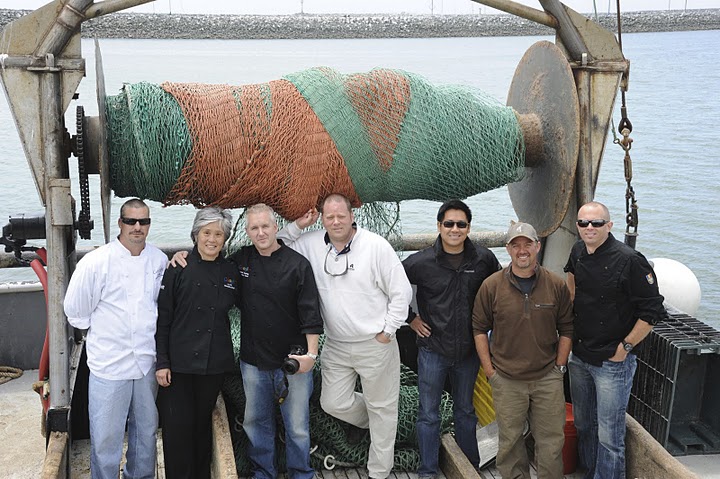
The Google Culinary team on a visit with fishermen in Half Moon Bay, Calif.—Quentin and I are the second and third from the left, in black.

We tend to think on a massive scale at Google—whether it’s how to deliver instant search results around the globe or help thousands of small businesses get online—but when it comes to feeding our employees at work and at home, it really comes down to a local touch. Knowing where our seafood, meat and produce come from, as well as knowing how they’re raised, farmed or harvested, makes all the difference in the on-the-ground work of sustainability. We see many bright spots ahead for our Community Supported Agriculture and Fishery programs, such as expansion to other offices and adding a grass-fed beef and pasture-raised poultry program. It’s exciting to work someplace where we can think big and local.

We know of two CSFs in the Bay Area. The Half Moon Bay Fishermen’s Association supplies only Google at the moment, but will soon add public drop-off sites—keep posted by visiting Farmigo.com. The other is CSea out of Bodega Bay. If you live elsewhere, we hope you’ll consider stepping up to create one in your area.

And even if you don’t live near the ocean or have direct access to fresh-caught seafood, the choices you make about what fish to purchase or order in restaurants can make a real difference. You may want to consider following the guidelines that we used for our Google Green Seafood policy: Whenever possible, purchase species caught locally and in-season, by small, independent fisher-families, using environmentally-responsible methods. We think it’s important to be responsive to the fluctuations of catch too, and source from fisheries that enforce catch limits or are guided by ecosystem-based management programs. As for us, we’ll continue to research and source responsibly managed farmed seafood, and always keep transparency and Googler health at the center of our program.


Tuesday, 28 June 2011

Examining the impact of clean energy innovation

At Google, we’re committed to using technology to solve one of the greatest challenges we face as a country: building a clean energy future. That’s why we’ve worked hard to be carbon neutral as a company, launched our renewable energy cheaper than coal initiative and have invested in several clean energy companies and projects around the world.

But what if we knew the value of innovation in clean energy technologies? How much could new technologies contribute to our economic growth, enhance our energy security or reduce greenhouse gas (GHG) emissions? Robust data can help us understand these important questions, and the role innovation in clean energy could play in addressing our future economic, security and climate challenges.

Through Google.org, our energy team set out to answer some of these questions. Using McKinsey’s Low Carbon Economics Tool (LCET), we assessed the long-term economic impacts for the U.S. assuming breakthroughs were made in several different clean energy technologies, like wind, geothermal and electric vehicles. McKinsey’s LCET is a neutral, analytic set of interlinked models that estimates the potential economic and technology implications of various policy and technology assumptions.

The analysis is based on a model and includes assumptions and conclusions that Google.org developed, so it isn’t a prediction of the future. We’ve decided to make the analysis and associated data available everywhere because we believe it could provide a new perspective on the economic value of public and private investment in energy innovation. Here are just some of the most compelling findings:
  • Energy innovation pays off big: We compared “business as usual” (BAU) to scenarios with breakthroughs in clean energy technologies. On top of those, we layered a series of possible clean energy policies (more details in the report). We found that by 2030, when compared to BAU, breakthroughs could help the U.S.:
    • Grow GDP by over $155 billion/year ($244 billion in our Clean Policy scenario)
    • Create over 1.1 million new full-time jobs/year (1.9 million with Clean Policy)
    • Reduce household energy costs by over $942/year ($995 with Clean Policy)
    • Reduce U.S. oil consumption by over 1.1 billion barrels/year
    • Reduce U.S. total carbon emissions by 13% in 2030 (21% with Clean Policy)
  • Speed matters and delay is costly: Our model found a mere five year delay (2010-2015) in accelerating technology innovation led to $2.3-3.2 trillion in unrealized GDP, an aggregate 1.2-1.4 million net unrealized jobs and 8-28 more gigatons of potential GHG emissions by 2050.
  • Policy and innovation can enhance each other: Combining clean energy policies with technological breakthroughs increased the economic, security and pollution benefits for either innovation or policy alone. Take GHG emissions: the model showed that combining policy and innovation led to 59% GHG reductions by 2050 (vs. 2005 levels), while maintaining economic growth.
This analysis assumed that breakthroughs in clean energy happened and that policies were put in place, and then tried to understand the impact. The data here allows us to imagine a world in which the U.S. captures the potential benefits of some clean energy technologies: economic growth, job generation and a reduction in harmful emissions. We haven’t developed the roadmap, and getting there will take the right mix of policies, sustained investment in technological innovation by public and private institutions and mobilization of the private sector’s entrepreneurial energies. We hope this analysis encourages further discussion and debate on these important issues.

Friday, 24 June 2011

An update on Google Health and Google PowerMeter

In the coming months, we’re going to retire two products that didn’t catch on the way we would have hoped, but did serve as influential models: Google Health (retiring January 1, 2012; data available for download through January 1, 2013) and Google PowerMeter (retiring September 16, 2011). Both were based on the idea that with more and better information, people can make smarter choices, whether in regard to managing personal health and wellness, or saving money and conserving energy at home. While they didn't scale as we had hoped, we believe they did highlight the importance of access to information in areas where it’s traditionally been difficult.

We’re making this announcement well in advance to give you plenty of time to download the information you might have stored in either product or to transfer it to another service, and we’re making it easy for you to do it in a variety of formats. More on how that works below.

More broadly, we remain committed as always to helping people around the world access and use information pertinent to them. We’ll continue to pursue this goal and to encourage government and industry to do the same.

Google Health
When we launched Google Health, our goal was to create a service that would give people access to their personal health and wellness information. We wanted to translate our successful consumer-centered approach from other domains to healthcare and have a real impact on the day-to-day health experiences of millions of our users.

Now, with a few years of experience, we’ve observed that Google Health is not having the broad impact that we hoped it would. There has been adoption among certain groups of users like tech-savvy patients and their caregivers, and more recently fitness and wellness enthusiasts. But we haven’t found a way to translate that limited usage into widespread adoption in the daily health routines of millions of people. That’s why we’ve made the difficult decision to discontinue the Google Health service. We’ll continue to operate the Google Health site as usual through January 1, 2012, and we’ll provide an ongoing way for people to download their health data for an additional year beyond that, through January 1, 2013. Any data that remains in Google Health after that point will be permanently deleted.

If you’re a Google Health user, we’ve made it easy for you to retrieve your data from Google Health any time before January 1, 2013. Just go to the site to download your information in any of several formats: you can print and save it, or transfer it to other services that support industry-standard data formats. Available formats include:
  • Printable PDF including all the records in your Google Health profile
  • Industry-standard Continuity of Care Record (CCR) XML that can be imported into other personal health tools such as Microsoft® HealthVault™
  • Comma-separated value (CSV) files that can be imported into spreadsheets and database programs for ongoing tracking and graphing
  • HTML and XML versions of the original “data notices” sent to your Google Health profile by linked data providers
  • A unified ZIP archive that includes all files you’ve uploaded to your profile, plus all of the formats above
Over the coming weeks we’ll also be adding the ability to directly transfer your health data to other services that support the Direct Project protocol, an emerging open standard for efficient health data exchange. And while we’ll discontinue the Google Health service at the beginning of 2012, we’ll keep these download options available for one more year, through the start of 2013. This approach to download and transfer capability is part of Google’s strong commitment to data liberation principles: providing free and easy ways for users to maintain control of their data and move it out of Google’s services at any time.

In the end, while we weren’t able to create the impact we wanted with Google Health, we hope it has raised the visibility of the role of the empowered consumer in their own care. We continue to be strong believers in the role information plays in healthcare and in improving the way people manage their health, and we’re always working to improve our search quality for the millions of users who come to Google every day to get answers to their health and wellness queries.

Google PowerMeter
We first launched Google PowerMeter as a Google.org project to raise awareness about the importance of giving people access to data surrounding their energy usage. Studies show that having simple access to such information helps consumers reduce their energy use by up to 15%; of course, even broader access to this information could help reduce energy use worldwide.

Since our launch, there’s been more attention given to this notion of people easily accessing their energy data. The installation of smart meters and other home energy devices is picking up steam, and states like California and Texas are moving forward to finalize policies and programs in this area. Earlier this month, the White House announced a goal of giving all consumers access to their energy usage in computer-friendly formats as part of a national plan for modernizing the electricity grid.

We’re pleased that PowerMeter has helped demonstrate the importance of this access and created something of a model. However, our efforts have not scaled as quickly as we would like, so we are retiring the service. PowerMeter users will have access to the tool until September 16, 2011. We have made it easy for you to download your data: simply log in to your account and go to "Account Settings” to export to a CSV (Comma Separated Values) file. We will be contacting users directly with more information on this process.

Momentum is building toward making energy information more readily accessible, and it’s exciting to see others drive innovation and pursue opportunities in this important new market. We’re proud of what we’ve accomplished with PowerMeter and look forward to what will develop next in this space.

By helping people make more informed decisions through greater access to more information, we believe Google Health and PowerMeter have been trailblazers in their respective categories. Ultimately though, we want to satisfy the most pressing needs for the greatest number of people. In the case of these two products, our inability to scale has led us to focus our priorities elsewhere.

As always, we welcome your feedback; please share your thoughts and opinions with us at health-feedback@google.com or powermeter-feedback@google.com. We won’t be able to respond to every email, but we promise we’ll listen.

Update 7/15/11: We've now added the ability to directly transfer your health data out of Google Health via the Direct Project protocol.

Tuesday, 14 June 2011

Helping homeowners harness the sun

(Cross-posted from the Green Blog)

Imagine sitting on your patio watching the sun’s rays pass overhead, knowing that they power your home with clean energy—at a cost that’s less that what you would have paid using just the grid. That’s what my colleague, engineer Michael Flaster, has been doing at his home in Menlo Park, Calif. since March of this year. He did it with the help of a company called SolarCity, which enables homeowners and businesses to begin using solar energy to power their homes and buildings.

Today, we’re announcing that we’ve investing $280 million to create a fund that will help SolarCity finance more solar installations across the country. This is our largest clean energy project investment to date and brings our total invested in the clean energy sector to more than $680 million. We’ve also launched a partnership to offer SolarCity services to Googlers at a discount.


In SolarCity’s innovative financing model, the company covers installation and maintenance of the system over the life of the lease. You can prepay, or pay nothing upfront after which you make monthly solar lease payments. All told, Michael will save $100 per month on his energy bills this year, and more than $16,000 over his 15 year lease, after factoring in his lease payment and lower energy bills.


We believe the world needs a wide range of clean energy options in the future, each serving different needs. We’ve already invested in several large-scale renewable energy projects, so we’re excited that this new partnership with SolarCity helps people power their homes directly with solar energy, too. We think “distributed” renewable energy (generated and used right at home) is a smart way to use solar photovoltaic (PV) technology to improve our power system since it helps avoid or alleviate distribution constraints on the traditional electricity grid.

Our investment is a quadruple-win for Google, SolarCity, its new customers and the environment. We continue to look for other renewable energy investments that make business sense and help develop and deploy cleaner sources of energy. Whether harnessing the sun on rooftops like Michael’s or in the desert sands of the Mojave, it’s all part of building a clean energy future.

Thursday, 9 June 2011

Leading the charge toward an electric vehicle fleet

(Cross-posted on the Green Blog)

Over the last few years, several innovative electric vehicle (EV) technologies have emerged in the marketplace and we’ve been working to update our green transportation infrastructure. As a result, we’ve now developed the largest corporate EV charging infrastructure in the country. We’re also including the next generation of plug-in vehicles in Gfleet, our car-sharing program for Googlers.

When Google.org launched the RechargeIt initiative in 2007, there were no commercially available plug-in hybrid EVs on the market. So we bought several Toyota Priuses and had them retrofitted with A123 Hymotion batteries to create our own mini-fleet of plug-in hybrids to demonstrate the technology. It was the birth of Gfleet, which has since become a valued perk and makes it easier for Googlers to use our biodiesel shuttle system to commute to work by providing green transportation options for people after they arrive at the Googleplex. The new Gfleet will include more than 30 plug-ins, starting with Chevrolet Volts and Nissan LEAFs, several of which have already arrived and are available for Googlers to use today. We’ll be adding models from other manufacturers as they become available.

To juice up our new cars and provide more charging options for Googlers, we’ve been working with Coulomb Technologies’ ChargePoint® Network to continue to expand our EV charging infrastructure. We’ve added 71 new and faster Level 2 chargers to the 150 Level 1 chargers we’ve installed over the last few years, bringing our total capacity to more than 200 chargers, with another 250 new ones on the way. The ChargePoint Network provides us the charging data necessary to track and report on the success of our green transportation initiative.

Overall, our goal is to electrify five percent of our parking spaces—all over campus and free of charge (pun intended) to Googlers. Our expanded charging system has already helped several Googlers decide to buy new EVs of their own, and we hope others will, too.


All told, Gfleet and our biodiesel shuttle system result in net annual savings of more than 5,400 tonnes of CO2. That’s like taking over 2,000 cars off the road, or avoiding 14 million vehicle miles every year! But we’re only one company, so we hope other companies think about how they can incorporate these new technologies into their own infrastructure. By supporting new, green transportation technologies, we’re enabling our employees to be green and doing our part to help spur growth in the industry.

Thursday, 2 June 2011

Practical steps towards a greener, energy-efficient cloud

(Cross-posted from the European Public Policy Blog)

Update June 14, 9:14am:
Videos of all the presentations at the Data Center Summit are now available on our website.

Data centers are very important to us—they’re critical to the cloud services we deliver. Over the last 12 years, we’ve put a lot of effort into minimizing the amount of energy, water and other resources we use—because it makes financial sense, and because it’s good for the environment too. That work means that today, we use half the energy of a typical industry data center.

Last week, we brought together more than 150 industry professionals in Zürich, Switzerland for our second conference on data center efficiency. Since our first conference two years ago in the U.S., the industry’s come a long way, with large operators now very focused on energy efficiency.


With “free cooling” we can dramatically reduce energy consumption by using the local environment to cool servers, instead of energy-intensive chillers. In our data centers we use both air cooling and evaporative cooling—and we revealed the details of the seawater cooling system we’ve custom-engineered for our new data center in Hamina, Finland.


Google is lucky enough to have the resources and experts to continually improve efficiency. But around 70% of the world’s data centers are operated by companies that probably don’t.

That’s why we shared five simple and low-cost steps that any company, large or small, can use. These include using plastic meat locker curtains to separate hot and cold air, or welding your own air-conditioning chimney out of cheap sheet metal. These techniques are proven to increase energy efficiency, reduce electricity consumption and improve environmental footprint.

We also announced that we’re now participating in the European Commission’s Code of Conduct for Data Centres, a framework for designing and operating data centers efficiently. It ties in closely with the way we build and run our facilities, and has a robust checklist of efficiency best practices that are well worth trying out.

The main take-away was that there is no magic in data center efficiency. With the right information and a bit of creativity, anyone can make their computing infrastructure efficient. If you operate a data center or server room, please visit our website and make use of the techniques we’ve outlined. Videos of all the presentations from the Summit will be available on the site next week.

Tuesday, 24 May 2011

Investing in the Alta Wind Energy Center

(Cross-posted from the Google Green Blog)

The Mojave Desert might be best known for its scorching sun and scary sidewinders, but the wind blows hard where the Mojave sands meet the Tehachapi Mountains in southern California, making it a great spot for wind turbines. It’s the site of the Alta Wind Energy Center (AWEC), which will generate 1,550 megawatts (MW) of energy when complete, making it one of the largest sites in the country for wind energy generation—enough to power 450,000 homes. Renewable energy developer Terra-Gen Power is constructing the site in several phases and we’ll provide $55 million to finance the 102 MW Alta IV project. Citibank, which has underwritten the equity for Alta Projects II-V, is also investing in this project.

We’re always looking for projects that are uniquely positioned to transform our energy sector. As part of the new 4,500 MW Tehachapi Renewable Transmission Project (TRTP), AWEC uses some of the first transmission lines developed specifically to transport renewable energy from remote, resource-rich areas (like the Mojave) to major population centers.

The Alta Wind Energy Center under construction

The Alta projects also employ an innovative financial structure called a leveraged lease, which has been used previously in the solar industry but has only recently become an option for wind projects. Under the leveraged lease, Google and Citi are purchasing the Alta IV project and will lease it back to Terra-Gen, who will manage and operate the wind projects under long-term agreements. We hope this structure encourages more investment by enabling other types of investors who might not typically consider wind projects.

The first five Alta projects are already operational, delivering 720 MW of energy to Southern California Edison, which will receive all 1,550 MW when completed, under a power purchase agreement signed with Terra-Gen in 2006. While Google won’t be purchasing the electricity from this project, AWEC will help California meet its ambitious renewable portfolio standard of 33 percent clean power by 2020. The whole site will boost California’s wind generation by 30 percent.

With this deal, we’ve now invested more than $400 million in the clean energy sector. We hope AWEC’s success, with its unique deal structure and renewable energy transmission, encourages more financing and development of renewables that will usher in a new energy future.

Update 6/22: Today, we’re increasing our investment in the Alta Wind Energy Center (AWEC) in Tehachapi, Calif. by providing another $102 million to finance the 168 MW Alta V Project. This adds to the $55 million investment we announced here last month for the 102 MW Alta IV project. We’ve now invested $157 million in 270 MW of clean, wind energy generation at AWEC. And that brings our total invested in this sector to more than $780 million, with over $700 million invested this year aloneall in projects that not only provide us strong financial returns, but also help to accelerate the deployment of over 1.7 GWs of clean renewable energy.

Friday, 29 April 2011

Celebrating Arbor Day with Save the Redwoods League and Google Earth

From time to time we invite guests to post about topics of interest and we’re pleased to have Emily Limm join us for U.S. Arbor Day. Emily is the science director for the non-profit Save the Redwoods League and is studying the impact of climate change on the redwood forests of northern California. To raise awareness about the League’s research, she worked with Google Earth Outreach to model old-growth redwoods on Google Earth. In this post, Emily shares her ideas on how technology and citizen science can help scientific research. -Ed.

Today is U.S. Arbor Day, a holiday established 120 years ago to celebrate our often under-appreciated forests, which provide us with necessities like clean air and drinking water as well as small pleasures like shade for a summer’s day picnic or a beautiful place to hike with crunchy leaves underfoot. Arbor Day holds special meaning for me because I spend most of my time in the coastal redwood forests of California, working to protect the world’s tallest tree species.

Over the past few months, Save the Redwoods League and the Google Earth Outreach team have collaborated to create 3D models of the old-growth redwood forest in Jedediah Smith Redwoods State Park in northern California, so you can now take a virtual hike among the ancient trees and cruise over towering treetops. Explore the park by activating the 3D trees layer in Earth (under 3D Buildings) and searching for [jedediah smith redwoods state park, ca]. Tilt your view angle toward the horizon to make the trees appear. You can download the KML file for the narrated tour about redwoods to view in Google Earth, or watch the video version below:


In order to protect redwoods in Jedediah Smith and elsewhere, my colleagues and I are working to collect data on geographic regions where the trees are currently thriving to determine how future forests will fare in our changing climate. A critical piece of our work is collecting and comparing field observations of redwoods across different climates, but we need more data to draw strong conclusions—and that’s where you come in.

Today, Save the Redwoods League is launching our citizen science project Redwood Watch, powered by iNaturalist.org, a platform for recording, organizing and mapping nature observations. By sharing a simple digital photograph of a redwood tree and the time and location where the picture was taken, you can help the League track and monitor the species. If you know of a redwood tree—perhaps in your own backyard or in a nearby park—you can use the free Redwood Watch iPhone application or your own camera to take a photo, add a comment and submit it online. iNaturalist stores your observation and, if geographical coordinates weren’t captured automatically, uses the Google Maps APIs to assign them to your photo. With your geolocated observation, we can zoom out and analyze your observation in the context of global environmental and climatic patterns.

An observation of a coast redwood submitted to the Redwood Watch on iNaturalist.org.

The more field observations Save the Redwoods League collects, the better we’ll understand what climate makes a healthy redwood today, and predict where the redwood forests of tomorrow will thrive. We hope to see you on the Redwood Watch.

Happy Arbor Day from Save the Redwoods League and Google Earth!

Note: There are plenty of parallel projects going on around the world, so if you don’t live near redwoods, consider participating in one of the other iNaturalist.org citizen science projects.

Friday, 22 April 2011

Celebrating Earth Day

Today, we’re celebrating Earth Day with an animated, interactive doodle on our homepage and events at Google offices around the world. At our headquarters in Mountain View, Calif., we’re holding an environmental fair for Googlers, complete with speakers and contests to strengthen Googlers’ green acumen, and a cookout using—what else—parabolic solar cookers (don’t worry, we’ll compost the leftovers).

Our campus garden in Mountain View

We’ve been carbon neutral since 2007 and—Earth Day or not—we’re always asking ourselves what we can do to make the world greener today than it was yesterday. This week, we launched a new website with many of the questions we’ve been asking over the years that have inspired our environmental initiatives. What can we do to make renewable energy cheaper than coal? How can we run a data center using 50 percent less energy? And what does it take to green our energy supply?

It’s questions like these that led us to install solar panels on our Mountain View campus in 2007—at the time, the largest corporate solar installation in the U.S. They’re also what made us decide to donate to Googlers’ favorite charities based on how often they self-power their commute, whether by bike or by pogo stick. We hope the new website helps you start asking bold questions that lead to innovative solutions to make the world a greener place.

In addition to our new site, we’ve had a busy few weeks continuing our green streak. We doubled down on greening our energy supply with our second power purchase agreement (PPA) in less than a year and made several new investments: at a solar photovoltaic plant in Germany (our first in Europe), and others in the largest wind farm and solar project in the world, bringing our total invested in clean energy to more than $350 million. While the investments won’t supply our operations with energy, we believe they make business sense and will spur development and deployment of compelling clean energy technologies.

This Earth Day, we’ll continue to ask ourselves what else we can do to bring us closer to true sustainability. We hope that you, and companies across the world, will be doing the same.

Thursday, 21 April 2011

Oklahoma, where the wind comes sweepin’ down the plain

Rodgers and Hammerstein weren’t kidding when they wrote what is now Oklahoma’s official state song. The gusts on the plains are fierce, which makes the Sooner State a great place to harness clean, renewable wind energy. Our commitment to greening our energy supply is also strong, which is why we’ve just signed a power purchase agreement (PPA) for wind energy—our second in less than a year—in Oklahoma.

The purchase is similar in size and structure to the agreement we signed last July for wind energy in Iowa, but this time we will be applying the power to our Mayes County, Okla. data center, which will be fully operational later this year. We’ve agreed to purchase all of the energy from NextEra Energy Resources’ Minco II wind facility in Oklahoma for the next 20 years, through Google Energy LLC, an entity that enables us to participate in the wholesale energy market. This 100.8 megawatt facility will be built as a direct result of our financial commitment and should be operational in late 2011.


We’ve made the commitment to be a carbon neutral company, and this purchase is part of our effort to minimize our impact on the environment. We’ve managed to reduce our energy consumption by over 50 percent by building highly energy-efficient facilities, but we know that efficiency alone isn’t enough to eliminate our carbon footprint. We’ve been exploring ways, such as this PPA, to reduce emissions further by increasing the amount of renewable energy we use to power our operations; we purchase high-quality carbon offsets for any remaining emissions.

If you’re interested in learning more about the whys and wherefores of our renewable energy purchases, we’ve just published a white paper (PDF) on the topic. Our hope is that by laying out our reasoning and methods we’ll make it easier for others in the industry to explore similar arrangements.

These purchases represent long-term, meaningful actions to reduce our carbon footprint and power our operations with clean electricity. Our infrastructure team will continue to seek similar opportunities globally as Google’s businesses continue to grow. As a company we hope that purchases like these, plus the additional $350 million we’ve invested in renewable energy projects, support the market and drive down the cost of clean energy. This will enable even more companies to invest in sustainable energy solutions.

Monday, 18 April 2011

Shepherding the wind

We recently invested approximately $100 million in the Shepherds Flat Wind Farm, anticipated to be the largest wind farm in the world. Shepherds Flat is currently under construction near windy Arlington, Ore., and when completed in 2012 will produce 845 MW of energy. That’s a lot of wind—enough to power more than 235,000 homes.

This project is exciting to us not only because of its size and scale, but also because it uses advanced technology. This will be the first commercial wind farm in the U.S. to deploy, at scale, turbines that use permanent magnet generators—tech-speak for evolutionary turbine technology that will improve efficiency, reliability and grid connection capabilities. Though the technology has been installed outside the U.S., it’s an important, incremental step in lowering the cost of wind energy over the long term in the U.S.

Shepherds Flat will help Oregon continue to be one of the top wind producing states in the nation, while providing significant direct economic benefits to the state. The project will also benefit the region by helping California meet its aggressive renewable energy goals with a cost-effective and clean wind resource. The electricity produced at Shepherds Flat will be sold under long term agreements to Southern California Edison.

The Shepherds Flat Wind Farm under construction with me in the center and my colleagues Arielle Bertman and Matthew Stepka.

We look forward to joining a project with strong experienced partners such as the developer, Caithness Energy, and GE, which is an early investor in Shepherds Flat as well as the turbine manufacturer and operations and maintenance supplier. Our co-investors are Sumitomo Corporation of America, a subsidiary of Sumitomo Corporation, and Tyr Energy, a subsidiary of ITOCHU Corporation, both of which have deep experience in power projects.

This project brings our total invested in clean energy to more than $350 million, including our most recent investments in a German solar photovoltaic plant and in the BrightSource Ivanpah solar power tower—the largest solar energy project in the world. We’re excited about helping deliver clean energy to the grid and we hope this latest investment encourages other companies to think about ways they can help accelerate the deployment of more renewable energy. We remain on the lookout for more projects that make business sense and will help all of us take advantage of clean, renewable energy.

Monday, 11 April 2011

Investing in the world’s largest solar power tower plant

We’ve invested $168 million in an exciting new solar energy power plant being developed by BrightSource Energy in the Mojave Desert in California. Brightsource’s Ivanpah Solar Electric Generating System (ISEGS) will generate 392 gross MW of clean, solar energy. That’s the equivalent of taking more than 90,000 cars off the road over the lifetime of the plant, projected to be more than 25 years. The investment makes business sense and will help ensure that one of the world’s largest solar energy projects is completed.

We need smart capital to transform our energy sector and build a clean energy future. This is our largest investment to date, and we’ve now invested over $250 million in the clean energy sector. We’re excited about Ivanpah because our investment will help deploy a compelling solar energy technology that provides reliable clean energy, with the potential to significantly reduce costs on future projects.

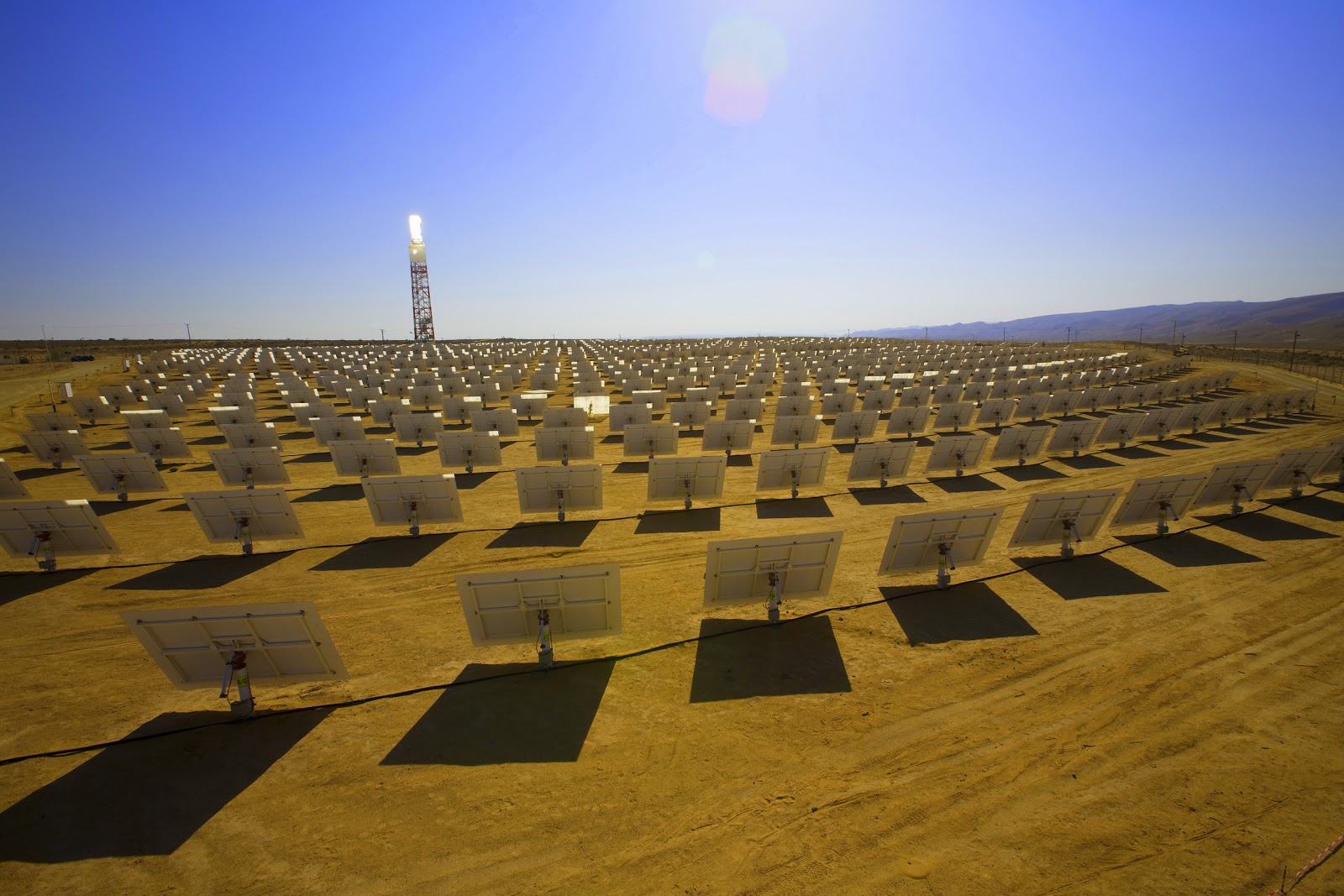
Power towers, which have been successfully demonstrated in the U.S. and abroad at smaller scale, are based on a relatively simple idea. The technology works by using a field of mirrors, called heliostats, to concentrate the sun’s rays onto a solar receiver on top of a tower. The solar receiver generates steam, which then spins a traditional turbine and generator to make electricity. Power towers are very efficient because all those mirrors focus a tremendous amount of solar energy onto a small area to produce steam at high pressure and temperature (up to 1000 degrees F). Think about burning a tuft of grass with a magnifying glass, only multiplied by thousands (or the original application: Archimedes’ heat ray that allegedly used mirrors to burn enemy ships!).

Brightsource Energy’s Solar Energy Development Center in Israel’s Negev desert

Several large solar projects are in the works in the sunny Southwest (and around the globe), but Ivanpah will be the first solar power tower system of this scale. The Ivanpah Power Tower will be approximately 450 feet tall and will use 173,000 heliostats, each with two mirrors. The project is being constructed by Bechtel, a major engineering firm. Construction began in October 2010, and is projected to finish in 2013.

The Ivanpah project will also be financed by NRG and with clean energy technology loan guarantees provided by the U.S. Department of Energy. We hope that investing in Ivanpah spurs continued development and deployment of this promising technology while encouraging other companies to make similar investments in renewable energy.

Monday, 20 December 2010

Going green at Google in 2010

(Cross-posted on the Google.org blog)

At Google, we’re committed to building a clean energy future because we we want to be good environmental stewards, and because we think it makes business sense. We’ve had a busy year with our clean energy initiatives. Take look at our redesigned green website and this new video from the Google green team to learn more about the priorities we’re pursuing:


As we look back on 2010, we wanted to highlight what we’ve been working on this year to help build a more sustainable future—for Google, and the world.
  • Greening our operations. We already have the most energy efficient data centers in the world, and use renewable energy whenever possible. This year we created a subsidiary, Google Energy LLC, to enable us to purchase renewable energy on the wholesale power markets and to help spur development in the sector.

    • Flexibility in buying renewable energy. In February, the Federal Energy Regulatory Commission (FERC) granted Google Energy LLC the authority to buy and sell energy on the wholesale market, giving us the flexibility to procure renewable energy at competitive prices.

    • 20-year green power purchase. Our FERC authority enabled Google Energy LLC to enter a 20-year green Power Purchase Agreement (PPA) in July to buy clean energy from 114 megawatts (MW) of wind generation at NextEra’s Story County II facility in Iowa (read more about how the deal is structured). By purchasing so much energy for so long, we’re giving the developer financial certainty to build additional clean energy projects.

  • Developing green products and tools. Just a few weeks ago, during the the U.N. Climate Change Conference in sunny Cancun, Mexico, we launched Google Earth Engine, a new Google Labs product. Google Earth Engine is a technology platform that makes an unprecedented catalog of imagery and data available online in one place for the first time. It enables global-scale monitoring and measurement of changes in the earth’s environment. We’re particularly excited about the initial use of Google Earth Engine to support efforts to stop global deforestation. We’ve also been busy this year incorporating green features into our products—like Google Maps biking directions and adding Carbon Disclosure Project ratings into Google Finance.

  • Investing in a clean energy future. To date, Google has invested over $100 million in clean energy. Google.org has already invested in several clean technology companies. We’ve also continued our internal R&D on renewable energy technologies (RE<C), substantially growing our engineering team. And this year, Google began making project investments that offer a solid financial return, and could have a transformational impact on the renewable energy sector.

    • North Dakota wind farms. In May, we invested $38.8 million in two North Dakota wind farms that generate 169.5MW, enough to power 55,000 homes. It was our first project investment, and uses some of the latest wind turbine technology and control systems to provide one of the lowest-cost sources of renewable energy to the local grid.

    • Offshore wind transmission. In October, we made a development stage investment in a project to build a backbone transmission line off the Mid-Atlantic coast. The project will put in place strong, secure transmission, removing a major barrier to scaling up offshore wind. When finished, the 350-mile line will connect up to 6,000MW of offshore wind energy—enough to serve approximately 1.9 million households!
It’s been a busy year at Google, and we believe the world needs better options in the future. As we head into the new year, we look forward to continuing our work to find and support innovative clean energy solutions.

Thursday, 2 December 2010

Introducing Google Earth Engine

(Cross-posted from the Google.org blog)

Today, we launched a new Google Labs product called Google Earth Engine at the International Climate Change Conference in sunny Cancun, Mexico. Google Earth Engine is a new technology platform that puts an unprecedented amount of satellite imagery and data—current and historical—online for the first time. It enables global-scale monitoring and measurement of changes in the earth’s environment. The platform will enable scientists to use our extensive computing infrastructure—the Google “cloud”—to analyze this imagery. Last year, we demonstrated an early prototype. Since then, we have developed the platform, and are excited now to offer scientists around the world access to Earth Engine to implement their applications.

Why is this important? The images of our planet from space contain a wealth of information, ready to be extracted and applied to many societal challenges. Scientific analysis can transform these images from a mere set of pixels into useful information—such as the locations and extent of global forests, detecting how our forests are changing over time, directing resources for disaster response or water resource mapping.

Congo Basin Water Map (detail): Original satellite image (left) and derived water map (right), created using Google Earth Engine [Potapov, P., Hansen,M. - South Dakota State University].

The challenge has been to cope with the massive scale of satellite imagery archives, and the computational resources required for their analysis. As a result, many of these images have never been seen, much less analyzed. Now, scientists will be able to build applications to mine this treasure trove of data on Google Earth Engine, providing several advantages:
  • Landsat satellite data archives over the last 25 years for most of the developing world available online, ready to be used together with other datasets including MODIS. And we will soon offer a complete global archive of Landsat.
  • Reduced time to do analyses, using Google’s computing infrastructure. By running analyses across thousands of computers, for example, unthinkable tasks are now possible for the first time.
  • New features that will make analysis easier, such as tools that pre-process the images to remove clouds and haze.
  • Collaboration and standardization by creating a common platform for global data analysis.
Google Earth Engine can be used for a wide range of applications—from mapping water resources to ecosystem services to deforestation. It’s part of our broader effort at Google to build a more sustainable future. We’re particularly excited about an initial use of Google Earth Engine to support development of systems to monitor, report and verify (MRV) efforts to stop global deforestation.

Deforestation releases a significant amount of carbon into the atmosphere, accounting for 12-18% of annual greenhouse gas emissions. The world loses 32 million acres of tropical forests every year, an area the size of Greece. The United Nations has proposed a framework known as REDD (Reducing Emissions from Deforestation and Forest Degradation in Developing Countries) that would provide financial incentives to tropical nations to protect their forests. Reaching an agreement on early development of REDD is a key agenda item here in Cancun.

Today, we announced that we are donating 10 million CPU-hours a year over the next two years on the Google Earth Engine platform, to strengthen the capacity of developing world nations to track the state of their forests, in preparation for REDD. For the least developed nations, Google Earth Engine will provide critical access to terabytes of data, a growing set of analytical tools and our high-performance processing capabilities. We believe Google Earth Engine will bring transparency and more certainty to global efforts to stop deforestation.

We’ve been working with several partners to fully develop this platform. In particular, the Gordon and Betty Moore Foundation has been a key strategic and funding partner. The Moore Foundation has also committed over $12 million dollars through its Environmental Conservation Program to projects that support the development of Google Earth Engine. The Moore Foundation’s Environment Program finances practical, enduring solutions to environmental challenges and works to improve the way society uses and manages important terrestrial, freshwater, and coastal marine ecosystems to create working land and seascapes that support resilient and productive ecosystems for current and future generations. They’ve funded the U.S. Geological Survey to scale their infrastructure and accelerate bringing historic Landsat data off tape, and online, through Google Earth Engine.


This animation shows the breadth and depth of the Landsat archive that has been uploaded into Google Earth Engine to date. We are grateful to the USGS for their ongoing technical collaboration.

Support from the Moore Foundation includes funding for several scientists to develop and integrate their desktop software to work online with the data available in Google Earth Engine. Those scientists—Greg Asner of the Carnegie Institution for Science and Carlos Souza of Imazon—are also key partners, along with Matt Hansen of the Geographic Information Science Center at South Dakota State University. All are at the cutting edge of forest monitoring in support of climate science.

In collaboration with Matt Hansen and CONAFOR, Mexico’s National Forestry Commission, we’ve produced a forest cover and water map of Mexico. This is the finest-scale forest map produced of Mexico to date. The map required 15,000 hours of computation, but was completed in less than a day on Google Earth Engine, using 1,000 computers over more than 53,000 Landsat scenes (1984-2010). CONAFOR provided National Forest Inventory ground-sampled data to calibrate and validate the algorithm.

A forest cover and water map of Mexico (southern portion, including the Yucatan peninsula), produced in collaboration with scientist Matthew Hansen and CONAFOR.

We hope that Google Earth Engine will be an important tool to help institutions around the world manage forests more wisely. As we fully develop the platform, we hope more scientists will use new Earth Engine API to integrate their applications online—for deforestation, disease mitigation, disaster response, water resource mapping and other beneficial uses. If you’re interested in partnering with us, we want to hear from you—visit our website! We look forward to seeing what’s possible when scientists, governments, NGO’s, universities, and others gain access to data and computing resources to collaborate online to help protect the earth’s environment.

Update on 12/6: Additional information on the Moore Foundation, Google Earth Engine’s Landsat archive, and the Congo Basin Water Map have been added to the post.