Showing posts with label crisis response. Show all posts

Wednesday, 31 August 2011

Using technology in crisis preparedness

(Cross-posted from the Google.org Blog)

In many ways, the arrival of Hurricane Irene last week drove home the importance of National Preparedness Month, an effort from the FEMA Ready campaign to encourage Americans to take steps to prepare for emergencies throughout the year. With people relying on the Internet worldwide, it’s not surprising that Google search data and a recently released American Red Cross survey show that people turn to online resources and tools for information and communication during major crises. First responders, who provide services in the aftermath of disasters, are also finding Internet and cloud-based tools and information useful—for improving their understanding of a situation, collaborating with each other and communicating with the public.

Today, in preparation for September’s National Preparedness Month, our Crisis Response team is introducing a new Google Crisis Preparedness website with information and educational tools on using technology to prepare for crises. On the site, you can see how individuals and organizations have used technology during crises in the past, including how two girls located their grandfather after the Japan earthquake and tsunami in March of this year and how Americorps tracked volunteers during the tornadoes in Joplin, Missouri in May of this year. There’s a section for responders with information on using Google tools in crises, such as collaborating efficiently using Google Docs, Spreadsheets and Sites, visualizing the disaster-related information with Google My Maps and Google Earth, and more.


Also, you can access a new public preparedness web resource launching today: Get Tech Ready, developed as a collaboration between FEMA, the American Red Cross, the Ad Council and Google Crisis Response. There, you’ll find tips on using technology to prepare for, adapt to and recover from disasters, for example:
  • Learn how to send updates via text and internet from your mobile phone in case voice communications are not available
  • Store your important documents in the cloud so they can be accessed from anywhere or in a secure and remote area such as a flash or jump drive that you can keep readily available
  • Create an Emergency Information Document using this Ready.gov Emergency Plan Google Docs Template, or by downloading it to record and share your emergency plans and access them from anywhere
We encourage you to take a moment now to see how simple, easy-to-use and readily-available technology tools can help you prepare for a crisis. You’ll be more comfortable using these tools in the event of a disaster if you’ve already tried them out—and even integrated them into your daily life.

Tuesday, 24 May 2011

Hacking for humanity in Silicon Valley and around the globe

(Cross-posted on the Code Blog and Google.org Blog)

Two years ago representatives from Google, Microsoft, Yahoo!, Hewlett-Packard, NASA and the World Bank came together to form the Random Hacks of Kindness (RHoK) program. The idea was simple: technology can and should be used for good. RHoK brings together subject matter experts, volunteer software developers and designers to create open source and technology agnostic software solutions that address challenges facing humanity. On June 4-5, 2011 we’ll hold the third Random Hacks of Kindness global event at five U.S. locations and 13 international sites, giving local developer communities the opportunity to collaborate on problems in person.


The RHoK community has already developed some applications focused on crisis response such as I’mOK, a mobile messaging application for disaster response that was used on the ground in Haiti and Chile; and CHASM, a visual tool to map landslide risk currently being piloted by the World Bank in landslide affected areas in the Caribbean. Person Finder, a tool created by Google’s crisis response team to help people find friends and loved ones after a natural disaster, was also refined at RHoK events and effectively deployed in Haiti, Chile and Japan.

We’re inviting all developers, designers and anyone else who wants to help “hack for humanity,” to attend one of the local events on June 4-5. There, you’ll meet other open source developers, work with experts in disaster and climate issues and contribute code to exciting projects that make a difference. If you’re in Northern California, come join us at the Silicon Valley RHoK event at Google headquarters.

And if you’re part of an organization that works in the fields of crisis response or climate change, you can submit a problem definition online, so that developers and volunteers can work on developing technology to address the challenge.

Visit http://www.rhok.org/ for more information and to sign up for your local event, and get set to put your hacking skills to good use.


Sunday, 10 April 2011

Messages for Japan

One month ago, a massive 9.0 earthquake and one of the worst tsunamis in history struck northeastern Japan. Many people in the most impacted areas still have immediate needs for shelter and supplies, and we’re continuing to help by maintaining the Crisis Response page and building tools and resources related to the disaster.

Since the crisis, people around the world have sent countless messages of hope and support to the people of Japan. Some of them showed sympathy for the victims. Others encouraged us to look forward. Reading these messages—many of them in English—you can’t help but feel the support coming from around the world. But we wished more people in Japan could hear from these supporters and feel that same sense of hope—even if the senders spoke another language.


So we had an idea: a site where people around the world could input messages for Japan in their own languages and have them automatically translated into Japanese while raising funds to help Japan. And today, we’re pleased to share messagesforjapan.com. On the site, you can submit messages and have them automatically translated to Japanese by Google Translate. Of course, people who speak Japanese can also post messages in Japanese if they’d like. You can see messages on the world map, browse them in their original language or in Japanese and donate to the rebuilding effort. We’re planning to deliver some of these messages to people in Japan via offline media as well.

In 1995, I was a volunteer in the disaster area following the Great Hanshin Earthquake in Kobe, Japan. After the craziness of first few weeks, I realized just how long it takes to recover from a disaster, and how important is it to rebuild not just the affected cities and towns but also people’s spirits. With this recent crisis, there’s no doubt that we have a long way to go. We hope that these messages from around the world will provide inspiration to the people of Japan as we face this challenge, and that the donations raised through this site and others will help the country on its road to rebuilding.

A final note: Donations raised via the Crisis Response page have exceeded five million dollars so far. We truly appreciate your contributions and thank you for your continued support.

Update April 13, 2011: Updated the YouTube video to correct a bug in how Arabic was displayed.

Monday, 4 April 2011

Google Crisis Response: a small team tackling big problems

This is the latest post in our series profiling entrepreneurial Googlers working on products across the company and around the world. Speed in execution is important for any Google product team, but as we learned after the recent earthquakes in both Japan and New Zealand, it’s even more critical in crisis response. This post is an inside look at the efforts of our year-old Crisis Response team, and what they’re doing to make preparedness tools available to anyone at the click of a button. - Ed.

The Google Crisis Response Team came together in 2010 after a few engineers and I realized that we needed a scalable way to make disaster-related information immediately available and useful in a crisis. Until a little over a year ago, we responded to crises with scattered 20 percent time projects, but after the Haiti earthquake in January 2010 we saw the opportunity to create a full-time team that would make critical information more accessible during disaster situations.

For us to help during a crisis, it’s vital to get things done really quickly, and we’ve been able to do that as a small team within Google. Working from a standard already developed by one of the Google engineers, Person Finder was built and launched in 72 hours after the Haitian earthquake, and it launched within three hours after the New Zealand earthquake in February. Unfortunately, there have been an unusually high number of disasters over the last year, forcing us to learn and get even faster.

Within minutes of hearing about the 9.0 magnitude earthquake off the coast of Japan in March, Googlers around the world—from engineers to webmasters to product managers—immediately started organizing a Google Crisis Response resource page with disaster-related information such as maps and satellite imagery, Person Finder and news updates and citizen videos on YouTube. In Japan, Person Finder went live within an hour of the earthquake. More than 600,000 contact entries have been made since then—more than all other disasters combined—and there have been several reports of people finding their loved ones safe. I was inspired by my colleagues’ ability to launch tools about an hour after the earthquake struck; the Tokyo office, in particular, has really been helping to drive the rapid response and provided real-time information to teams across the globe, even while aftershocks were rocking the city and buildings were still swaying.


But we’re eager to find other ways of helping. In addition to these efforts focused on specific situations, we’ve worked hard this past year to more broadly organize the information most helpful during crisis situations and make it possible for people to use that data in near real-time. If people are asking for information, then in our view, it’s already too late. In these situations, it’s incredibly important that things happen fast.

So in addition to building products, we collaborate with many incredible organizations to make technology useful for responding to a crisis. For example, Random Hacks of Kindness is a collaboration between technology companies and government organizations which encourages teams around the world to create software solutions to problems that arise during a crisis. Recent “RHoKstars” have created all sorts of useful tools—from HeightCatcher, which helps identify malnourishment of children in relief camps by accurately assessing height and weight through a mobile device, to new features for Person Finder, such as email notifications, automatic translation and phonetic name matching—which have all been extremely useful in Japan. These projects present a real opportunity to improve lives by employing crowd-sourcing technology and real-time data during a crisis.

The sheer number of major natural disasters in 2010 and early 2011 demonstrates just how important it is for those involved in relief efforts to have real-time access to information no matter where they are. The Google Crisis Response team has worked over the past year to develop open source initiatives that encourage collaboration with larger crisis response efforts, including relief organizations, NGOs and individual volunteers. And although we’re a small team and still relatively new to the crisis response ecosystem, we hope the resources and support we receive from Google and our community partners around the world will make a difference in preparedness efforts.

Wednesday, 30 March 2011

New imagery of Japan after the earthquake

(Cross-posted from the Lat Long Blog)

It’s now the third week after the devastating 9.0-magnitude earthquake that struck northeastern Japan. Aid organizations have been hard at work and cities are starting to show signs of recovery, but the damage is beyond imagination and there are still thousands of people at shelters grappling with daily challenges. As a native of Sendai city, I’m still speechless seeing the destruction and damage that has been done to the places I love and care about.

We’ve been looking for ways we can assist in the relief efforts using Google’s map-related tools. A few days after the quake, we published updated satellite imagery of northeast Japan in Google Maps and Google Earth, which illustrated the massive scale of devastation in the affected areas.

Today, we’ve published imagery of the Sendai region at even higher resolution, which we collected on Sunday and Monday. The new Sendai imagery, along with satellite imagery from throughout the area, is now live in the base imagery layer of Google Earth and will soon be visible in Google Maps. We hope to continue collecting updated images and publishing them as soon as they are ready.

We hope our effort to deliver up-to-date imagery provides the relief organizations and volunteers working around the clock with the data they need to better understand the current conditions on the ground. We also hope these tools help our millions of users—both those in Japan and those closely watching and sending their support from all over the globe—to find useful information about the affected areas.

A riverside neighborhood in Sendai from our newly released imagery

Thursday, 17 March 2011

More resources for those affected by the Japan earthquake and tsunami

(Cross-posted from the Google.org Blog)

Like the rest of the world, we’ve been transfixed by the images and news coming out of the northeastern part of Japan over the past six days. Our hearts go out to those who have been affected by this devastation and we’re deeply grateful to those who are working to keep us safe. In the meantime, Googlers in Japan and elsewhere around the world have been working around the clock to try and help improve the flow of information. Here are some of the recent developments we’ve been working on:

Centralized information
Our Crisis Response page—now in Japanese, English, Chinese and Korean—organizes all of Google’s efforts, with links to valuable resources such as emergency hotlines, Person Finder, blackout schedules, maps and links to relief organizations receiving donations. Ninety-three percent of mobile users in Japan don’t have top-of-the-line smartphones, so we’ve recently optimized this Crisis Response page to make it more readable for a wider range of devices. You can also access that version by scanning this QR code:

Person Finder
Within the first two hours of the earthquake, we launched Person Finder so people can enter the names of those they’re looking for or have found. You can now also search by entering mobile phone numbers to see if they match any listings. And as with the Crisis Response page, Person Finder has also been optimized for those without smartphones. There are currently more than 250,000 records in the database (including names shared with us by NHK, the national broadcaster in Japan) and we’ve heard several reports of people who have found their loved ones safe.

To help the many people in shelters get word of their whereabouts to loved ones, we’re also asking people in shelters to take photos of the handwritten lists of names of current residents and email them to us. Those photos are automatically uploaded to a public Picasa Web Album. We use scanning technology to help us manually add these names to Person Finder; but it’s a big job that can’t be done automatically by computers alone, so we welcome volunteers with Japanese language skills who want to help out.

Satellite images
We’re also working with our satellite partners GeoEye and DigitalGlobe to provide frequent updates to our imagery of the hardest-hit areas to first responders as well as the general public. You can view this imagery in this Google Earth KML, browse it online through Google Maps or look through our Picasa album of before-and-after images of such places as Minamisanriku and Kesennuma.

Mapping
You can follow developments on the ground by looking at several maps that track changing developments. We’ve mapped rolling blackouts for areas that are affected by power outages. With data given to us by Honda, you can now see which roads have been recently passable on this map or this user-made Google Earth mashup with new satellite imagery. We’re also constantly updating a master map (in Japanese and English) with other data such as epicenter locations and evacuation shelters. And with information from the newspaper Mainichi, we’ve published a partial list of shelters.

Translation
Use Google Translate for Japanese and 56 other languages. You can paste in any text, or enter the address of any web page for automatic translation. We also just released an early experimental version of Google Translate for Android to help non-Japanese speakers in affected areas.

Donations
Visit our Crisis Response resource page to find opportunities to donate. When you donate to Japan relief efforts through Google Checkout, we absorb processing fees—so 100% of your money goes to the organizations. Google has also donated $250,000 to help the people of Japan recover.

To keep up with the latest developments on our efforts in Japan, follow @googlejapan (tweets are mostly in Japanese) or @earthoutreach (for our mapping and imagery efforts) on Twitter.

Saturday, 12 March 2011

Post-earthquake imagery of Japan

(Cross-posted from the LatLong Blog)

In response to the devastating earthquake and subsequent tsunami that struck Japan, we’ve worked with our satellite imagery providers to get the latest available data of the areas affected most.

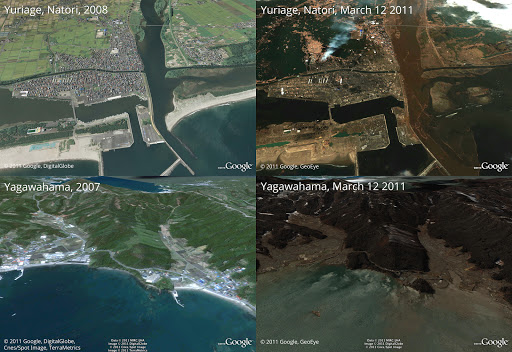
To view this high-resolution imagery, courtesy of our partners at GeoEye, download this KML file and explore it in Google Earth. You can also explore the imagery with Google Maps, or have a look at this Picasa album of before-and-after shots. Here’s a sample:

Before and after the earthquake and tsunami. Above is Yuriage in Natori, below is Yagawahama; both are in Miyagi prefecture. High-resolution version of this photo.

We’re working to provide this data directly to response organizations on the ground to aid their efforts. We hope this new updated satellite imagery is valuable for them as well as everyone else following this situation to help illustrate the extent of the damage.

You can find more information regarding the disaster and resources for those in need at our Crisis Response page in English and Japanese. You can also follow @earthoutreach on Twitter to stay up to date with our mapping and imagery efforts.

Assembling resources following the earthquake in Japan

(Cross-posted from the Google.org Blog)

I was in the middle of writing code when the Google Japan office, on the 26th floor of Roppongi Hills in Tokyo, started shaking slowly. The rocking gradually increased, and I looked out the window to see the surrounding buildings all swaying ominously. Although alerts from the building urged us to evacuate via the emergency stairs, I couldn't help but stay and search for information about the earthquake’s epicenter and scale. Amidst a series of aftershocks rocking our office, a small group of us in Tokyo and several other Google offices started gathering information about the earthquake to create the Crisis Response information page.

As someone who experienced the Kobe earthquake 16 years ago when I was at university, I cannot forget the immediate desire for information. There was no way to find out where people's family and friends were, if transportation would be available to get us home, and most importantly, whether we would be able to find shelter.

This experience helped me remember that during a crisis, information about shelters can become increasingly muddled. Together with our Google Crisis Response team, we decided to organize existing public information from local governments about the concerned areas. Because of the very high volume of web traffic yesterday, this proved difficult to access. Collaborating with the Google Maps engineering team in Tokyo, we rapidly put together a page of information on Google Maps for our Crisis Response page.

And thanks to our colleagues in California and around the globe, within one hour of the earthquake we launched Google Person Finder, a tool to help locate missing people, in Japanese, Chinese and English. We published sites in Japanese and English with maps, news updates, videos and resources. We also posted tsunami alerts on the Google homepage for appropriate domains to make sure as many people as possible saw the warning. And in addition to these tools we've made available, we are donating $250,000 to organizations in Japan who are working on relief and recovery efforts.

Our hearts go out to those who have been affected by the tragedy, and we thank the citizens, first responders and organizations working hard to keep everyone safe.

Monday, 31 January 2011

Some weekend work that will (hopefully) enable more Egyptians to be heard

Like many people we’ve been glued to the news unfolding in Egypt and thinking of what we could do to help people on the ground. Over the weekend we came up with the idea of a speak-to-tweet service—the ability for anyone to tweet using just a voice connection.

We worked with a small team of engineers from Twitter, Google and SayNow, a company we acquired last week, to make this idea a reality. It’s already live and anyone can tweet by simply leaving a voicemail on one of these international phone numbers (+16504194196 or +390662207294 or +97316199855) and the service will instantly tweet the message using the hashtag #egypt. No Internet connection is required. People can listen to the messages by dialing the same phone numbers or going to twitter.com/speak2tweet.

We hope that this will go some way to helping people in Egypt stay connected at this very difficult time. Our thoughts are with everyone there.

Update Feb 1, 12:47 PM: When possible, we're now detecting the approximate (country-level) geographic origin of each call dialing one of our speak2tweet numbers and attaching a hashtag for that country to each tweet. For example, if a call comes from Switzerland, you'll see #switzerland in the tweet, and if one comes from Egypt you'll see #egypt. For calls when we can't detect the location, we default to an #egypt hashtag.

Wednesday, 12 January 2011

Haiti, one year after the earthquake

It’s been one year since the 7.0 magnitude earthquake struck Haiti, and governments and NGOs are continuing to respond, many using high-resolution images of the area. To support these efforts, we’ve updated our aerial imagery in Google Earth of the Port-au-Prince area to include images from before and after the earthquake, as well as made updates throughout 2010. These pictures provide an evolving view of the movement of people, supplies and rubble.

To access this imagery directly, use the Historical Imagery feature of Google Earth.

Complementing our online efforts with this imagery, a webpage and crisis response tools such as Person Finder, Google has made an effort to contribute to relief in Haiti by providing technical and financial support to NGOs. These organizations such as Doctors Without Borders and Partners in Health and specific technology NGOs such as Samasource and Frontline SMS continue to help the Haitian people. We’ve looked to them to help us guide our ongoing response to this crisis.

In November, we gathered updated aerial imagery, and sent a second wave of Google teams to Haiti to evaluate our earlier response efforts and see where Google could continue to provide help. We met with local Haitians and technology NGOs under tents, in trailers, in Internet cafes and at restaurants.

From these visits we witnessed the difficulty involved in using our mapping tools under the unpredictable nature of the Internet in Haiti, and so have focused on developing better offline capabilities and have proposed ideas for improving overall Internet access in Haiti. We also ran training for aid workers on our collaborative tools like Google Apps, which can help coordinate resources. While there, we spent time understanding how NGOs are combating the cholera epidemic, and brainstorming tools that could help aid workers produce specialized maps of epidemic case data and chlorination levels at water points, which are critical for planning and prevention.

If you’re interested in helping with Google’s efforts in Haiti, you can:
Our experience and the updated imagery demonstrate that there are still significant needs on the ground in Haiti. We’re continuing our efforts to support locals and NGOs and look forward to seeing how technology will continue to help both Haitians and victims of disasters worldwide.

Tuesday, 21 September 2010

Our Clinton Global Initiative commitment to Pakistan

At the opening ceremony of the Clinton Global Initiative (CGI) this morning, President Clinton discussed the urgent need to help the people of Pakistan recover from widespread floods which have affected more people than the 2004 South Asia tsunami, the 2005 South Asia earthquake, and the Haiti earthquake combined. The floods have put one-fifth of the land underwater, impacting more than 20 million people, damaging or destroying 1.9 million homes, putting 3.5 million children at risk of waterborne diseases, and wiping out livestock and crops.

Unfortunately the global response has been anemic. While U.S. corporations, foundations and individuals responded admirably to the earthquake in Haiti by donating $900 million in the first five weeks after the disaster, that same group donated $25 million to Pakistan in the first five week weeks after the floods hit. In an interview with citizens hosted by YouTube, President Clinton called for a dramatically increased global response.

As part of our CGI commitment this year, Google is providing $1 million in charitable grants, as well as technology support to help the people of Pakistan recover from these floods. Roughly one-third of our grants support organizations providing clean water, shelter, medical care and other immediate needs, while two-thirds will be focused on longer-term rebuilding efforts. Partners for the first round of support include: A.S. Edhi International Foundation, Architecture for Humanity, CARE, The Citizens Foundation, Naya Jeevan for Kids, Real Medicine Foundation, SIUT North America, Sungi Development Foundation and UM Healthcare Trust.

Amazing work is already being done by these organizations. SIUT, for example, has already established seven medical relief camps and three field hospitals in different parts of the country. Their doctors and paramedics have treated more than 100,000 people, many of whom are suffering from gastroenteritis, malaria and skin diseases.

In remarks during the opening plenary today, Eric Schmidt noted the importance of bringing 21st century technology solutions to disaster relief work. In collaboration with numerous NGOs, for example, Google developed Person Finder, an application that allows individuals to check on the status of friends and loved ones affected by a disaster, a few days after the Haiti earthquake. We developed Resource Finder, an experimental tool that aggregates information on health facilities to help first responders, and shared our MapMaker data with the U.N. We’ve published sites linked from our homepage to provide updated maps and imagery, videos, news and ways to donate in the wake of recent natural disasters in Haiti, Chile, China, Pakistan and the Gulf oil spill.

We’re excited to be at CGI this week to learn about innovative ways to use technology to assist with health, development and disaster response. We encourage non-profits to visit our newly updated Google for NonProfits site to learn how Google’s free tools can help expand the impact of each organization.

Friday, 10 September 2010

Responding to the fires in San Bruno

Update at 6:27pm: We now have updated satellite imagery (from GeoEye) of the area. You can download it here and view it in Google Earth.
Update on Sep 11: These before and after images show the extent of damage in one area of San Bruno.

Before

After

Like many friends in the Bay Area and across the country, I’ve been stunned by the images of raging fires in San Bruno. Nearly 40 structures have been destroyed and 120 damaged, with several fatalities and multiple injuries after the explosion of a gas line. More than 100 people have been evacuated to nearby shelters.

This disaster strikes close to home; our YouTube offices are about two miles away from the main gas explosion. We’re thankful that no Google employee was hurt, but remain concerned for the well-being of our neighbors in the area.

We are donating an initial amount of $50,000 to the American Red Cross Bay Area Chapter to help with relief efforts. We’re directing Googlers to the local blood drives today and will be hosting blood drives in our San Bruno, Mountain View and San Francisco offices early next week.

We’ve created this map to show the location of the explosion and highlight nearby shelters and resources. The map is open for collaboration and welcomes additional useful information. We encourage you to embed it in your website or blog. We are also exploring the possibility of obtaining updated imagery of the area to help responders visualize the scope of the disaster.


View San Bruno Gas Explosion in a larger map

Our hearts go out to our neighbors who have been affected by the explosion. We thank the firefighters and first responders who have been working tirelessly to contain the fires and help the residents of San Bruno. You can donate to help here.

Friday, 13 August 2010

Responding to the floods in Pakistan

Pakistan has been struck by the worst flooding in its recorded history. The latest estimate of the number of people affected by the flood exceeds 14 million—more than the combined total of the 2004 Indian Ocean tsunami, the 2005 Kashmir earthquake and the 2010 Haiti earthquake. Critical infrastructure has been damaged over the last two weeks and clean water is in short supply. As monsoons approach, flooding is expected to worsen.

Our Crisis Response team has been working to use existing tools and build new ones to help the relief efforts. We just launched a page in Urdu and English where you can find information, resources and donation opportunities to help the victims of the floods. We’re also donating $250,000 to international and local NGOs to immediately aid in relief efforts. Although we’ve been able to provide satellite imagery for disasters in the past, cloud cover in Pakistan has prevented us from compiling useful imagery so far. We hope to share imagery as soon as possible.

We’ve already learned a lot about building useful tools from our previous efforts to help with disaster relief. Following the earthquake in Haiti, a small team of Googlers visited relief aid workers in Haiti to understand how we could further help. In observing and speaking with the relief aid workers, we learned that they needed up-to-date information about available resources (such as which field hospitals have X-ray machines or orthopedic surgeons), their location and contact information. Coordination between various health and relief facilities that spring up in a disaster zone can be challenging.

Based on what we learned in Haiti, we’ve been working to develop Resource Finder, a new tool to help disseminate updated information about which services various health facilities offer. It provides a map with editable records to help relief workers maintain up-to-date information on the services, doctors, equipment and beds available at neighboring health facilities so that they can efficiently arrange patient transfers. We normally wouldn’t release the tool so quickly, but decided to make an early release version of Resource Finder available for supporting relief efforts in Pakistan. This is the first time the tool is being launched during a disaster situation so we’ll be working closely with NGOs to understand its usefulness and will iterate accordingly.


We’ve also launched Person Finder in both Urdu and English for this disaster. This application allows individuals to check and post on the status of relatives or friends affected by a disaster. Fortunately, we’ve heard that missing persons has not been as concerning an issue as it was during the earthquakes in Haiti and Chile, but we’ll leave the application up regardless.

Responding to a disaster of this scale is a daunting task, but we can all do something to help. We will try to do our part and continue working with the many incredible NGOs to develop tools that help them work more effectively.

Friday, 21 May 2010

Keeping up-to-date on the Gulf of Mexico oil spill

(Cross-posted on the Lat Long blog)

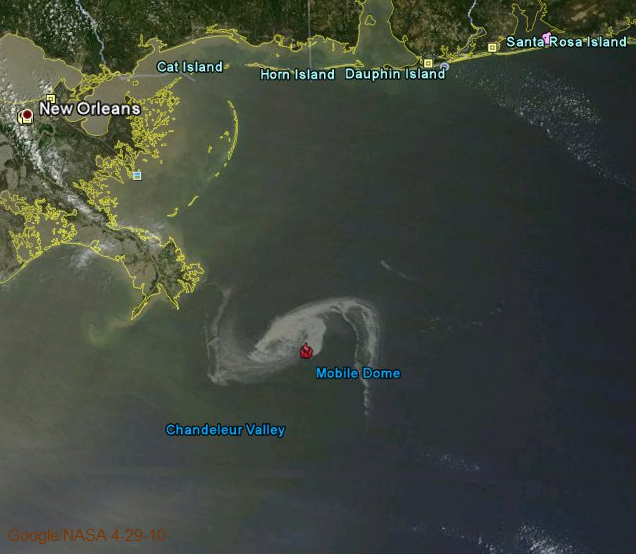
It is estimated that at least 6 million gallons of oil have leaked into the Gulf of Mexico since the Deepwater Horizon explosion a month ago. Cleanup efforts are underway, but the oil has spread extensively around the Gulf and along the southern U.S. coastline. Oil has begun washing up on the beaches of Louisiana and the delicate wetlands along the Mississippi River, and can spread to Florida and throughout the Gulf as weather conditions change. This sequence of images, coming from NASA’s MODIS satellites, illustrates the movement and growth of the oil slick over the past few weeks:

April 25, 2010


April 29, 2010


May 9, 2010


May 17, 2010

The last image, taken earlier this week (on May 17), shows the coastal areas currently at risk from the spreading oil, and can help those working on the wide range of relief efforts.


You can view this and other MODIS imagery in Google Earth by downloading this KML. You can also view additional imagery and find other resources and news at our oil spill crisis response page.

Tuesday, 4 May 2010

Mapping the Gulf oil spill in Google Earth

Two weeks ago, there was a fatal explosion on the offshore oil rig Deepwater Horizon in the Gulf of Mexico. The rig sank shortly afterwards, and since then the well has been leaking crude oil into the Gulf, spreading an oil slick towards the U.S. Gulf Coast. This spill is pouring as many as 5,000 barrels (210,000 gallons) of oil a day into the Gulf and poses a serious threat to coastal industries, sensitive habitats and wildlife, including numerous species along the coastal areas of Louisiana, Mississippi, Alabama and Florida. Many government agencies and other organizations have made data publicly available, which we’ve compiled on our crisis response site dedicated to the spill.

Last week we made imagery from NASA’s MODIS available as an overlay for Google Earth, which currently shows the extent of the oil spill through April 29, and we’ll continue to add more imagery as it becomes available. We’ve also made radar images from ESA’s ENVISAT available through this KML file. Below, you can see the progression of the spill over time.


To view this imagery and other datasets in Google Earth, turn on the “Places of Interest” layer in the Layers panel on the left-hand side of Google Earth, then navigate to the Gulf of Mexico and click on the red icon.


In addition to this imagery, our site contains maps of the locations of the oil, fishing closures and affected areas, the ability to upload videos directly to YouTube, and a link to a site where people in the area can contribute their observations. We hope these resources are useful to those affected by the spill, those responding to it and those learning about its devastating effects on the people and environment of the Gulf Coast.

Monday, 19 April 2010

Imagery for Qinghai, China earthquake

(Cross-posted from the Google LatLong Blog)

On Tuesday, April 13, a powerful 6.9 earthquake shook the province of Qinghai, China, resulting in widespread destruction and the loss of more than 1,700 lives. Working closely with GeoEye, we’ve been able to acquire some high resolution post-earthquake imagery, which vividly illustrates the magnitude of this tragic event.

(click image to view full-size; click here to view in Google Earth)

To see more of this imagery, you can download the KML here and open it in Google Earth.

In addition, an international team, including many of our Chinese Googlers, have worked to create a Crisis Response page for the earthquake with several additional resources:
  • The China Person Finder tool, which can be used to submit or search for information about individuals who may have been affected. It is available in Simplified Chinese, Traditional Chinese and English, and is accessible on mobile. We encourage organizations and media sites to embed the gadget on their sites and help spread the word.
  • Google News and real-time search, which features posts to Twitter and other sources. This provides the latest information from authoritative sources and people on the ground.
  • A My Map to help users contribute data about Qinghai, such as the conditions in specific areas and rescue efforts underway.
The Chinese version of this page can be accessed from a link on our homepages on google.com.hk and google.com.tw, and we will continue to update the pages as more materials become available.

Friday, 15 January 2010

Staying connected in post-earthquake Haiti

With relief efforts underway, many displaced Haitians and their friends and families around the world are deeply concerned about the safety and whereabouts of loved ones. In response to the Haitian earthquake, a team of Googlers worked with the U.S. Department of State to create an online People Finder gadget so that people can submit information about missing persons and to search the database.


You'll find this gadget on our Haiti earthquake response website as well as on the State Department website. In order to prevent the proliferation of multiple missing persons databases (a big problem during Hurricane Katrina), we've made the People Finder gadget standards-based and easily embeddable on any website (see here for instructions). The gadget is currently available in English, French and Creole.

We're also helping families in the U.S. stay connected with their loved ones in Haiti by offering free calls to Haiti for the next two weeks via Google Voice. If you don't have a Google Voice account already, request an invitation at www.google.com/voice.

For anyone interested in viewing updated imagery in Google Earth, we've now included GeoEye's shots from Wednesday in the Historical Imagery feature. Now you can view the imagery without downloading the KML file and can use the time slider to easily compare the stark before-and-after images, such as those below. To help relief organizations, GeoEye has made professional-quality files of their recent satellite imagery of Haiti downloadable via our earthquake response website. We hope the imagery in this format will be valuable to GIS organizations and aid workers.

(Click to see full-size)

We have also made Haiti Map Maker data publicly available for download for non-commercial use and attribution. Data can be used by relief workers to do things such as create offline maps, combine data sets and run analysis, all of which we hope will help with their efforts on the ground. Please help improve Haiti maps with Google Map Maker.

News and user footage continues to roll into YouTube. Oxfam and the American Red Cross are even responding to donations by uploading videos that show viewers exactly where their contributions are making a difference.

Thursday, 14 January 2010

Helping Haiti respond to the earthquake

(Cross-posted on the Google.org blog)

These recent satellite images of Port-au-Prince, Haiti before and after Tuesday's earthquake dramatically show the devastation caused by magnitude 7.0 trembler. Here are before-and-after screenshots of the National Palace and an area of Port-au-Prince:

Click to see full-size

In order to help the people of Haiti respond to this catastrophe, Google is donating $1 million to organizations on the ground that are rescuing those still trapped and providing clean water, food, medical care, shelter and support to those affected. We'd like to make it easy for anyone moved by the tragedy to respond as well, so we've included a link on our homepage to information, resources and ways you can help, including information on how to donate to organizations including: Direct Relief, Yele Haiti, Partners in Health, Red Cross, World Food Program, Mercy Corps, Save the Children, Lambi Fund, Doctors Without Borders, The International Rescue Committee.

You can also use the below buttons to donate to UNICEF or CARE.

Donate to CARE
$


Donate to UNICEF
$


In addition, Map Maker data has been made available to U.N. organizations and the team is working with the Map Your World Community to encourage Map Maker users with on the ground knowledge to help update the map of Haiti with disaster response data. We've received requests from relief organizations and our users to publish recent satellite imagery of the country. One of our imagery partners, GeoEye, has provided us with post-earthquake imagery from Haiti. You can check our Lat Long blog for further updates.

We've also reached out to the YouTube community for help. A Spotlight on the homepage drives traffic to videos from Oxfam and the American Red Cross, where you can make donations to relief efforts. We're also keeping a running playlist of the video footage coming out of Haiti on Citizentube; you can find a broad collection of citizen reports, news wire clips and personal stories of some of the victims.

Update at 1:11: Details regarding YouTube involvement corrected.

Friday, 2 October 2009

Helping the victims of Tropical Storm Ketsana

Last weekend, Tropical Storm Ketsana (local name "Ondoy") pounded Manila and nearby areas of the Philippines with a month's worth of rain in just a few hours, resulting in floods that covered 80% of the city with as much as 20 feet of water. The typhoon left in its wake nearly 300 people dead and hundreds of thousands displaced.

We're very saddened by the losses the Filipino people have sustained during this calamity. To help you stay up to date on the disaster and contribute to the relief efforts, we've put up a Help for Typhoon Ondoy Victims in the Philippines page that contains the latest news from local media outlets, lists of verified donation sites and emergency hotlines, and a volunteer-maintained map of persons needing rescue.

Filipinos have been posting videos of the flooding and its aftermath on YouTube. You can also visualize the overflows along main rivers and bays in Google Earth with this kmz file.

If you're familiar with Google Maps and would like to get involved in the effort to map missing persons, relief centers and road conditions, you can email the volunteer team at typhoonondoy@googlegroups.com. We will continue to update the page with the latest information and imagery, and keep your eye on the Lat Long blog for updates about disaster relief efforts.

Monday, 19 May 2008

Responding to the earthquake in China


One week ago, an earthquake of 7.8 magnitude struck in Sichuan. Everyone in China was shocked and then heartbroken as reported deaths climbed from 10,000 to 20,000 to more than 32,000 people. The death toll is still rising, and the number of injured and missing is many times greater.

But the Chinese people have faced this disaster with resilience, compassion, and courage. There have been non-stop airlifts, blood donations, and rescue missions. One bold executive drove hundreds of miles in his jeep, started digging, and saved several lives. Taxi drivers stopped carrying passengers and drove to affected areas to help. One hundred thousand brave soldiers risked (and some gave) their lives to look for every possible survivor. Here in Beijing more than a thousand families have volunteered to adopt children who have lost their parents. Everyone is eager to help -- and that includes Googlers.

Within hours of the earthquake, our China-based teams pulled together to use Google's resources and technology to help. At the request of the government, we obtained new satellite images of Sichuan province (Earth KML) to help them better focus their recovery efforts. We developed and launched a “lost loved one” search based on our Custom Search Engine (CSE). To populate the CSE index, hundreds of Googlers worked around the clock looking through published tables, hospital records, news reports, and community sites. We tuned our Chinese news search, video search, image search, blog search, and oneboxes. We also partnered to build community sites, and launched both homepage promotions and a map-based information page. Google China has an extremely dedicated and passionate team and I am deeply honored to work alongside them.

In addition to these efforts here in China, Googlers worldwide have also made substantial financial donations to the relief operations. As a company, we’ve committed $2 million for disaster relief and rebuilding, in addition to donating a large advertising budget for donation ads and public service announcements to aid organizations throughout the world.

We have also created a Google Checkout donations page so you can easily donate to Mercy Corps, which works with the China Foundation for Poverty Alleviation, or the Tsinghua Foundation, which works with the Red Cross Society of China. Both organizations have assured us that all of the proceeds will go directly to earthquake relief.

Our efforts are but one piece of a giant effort now underway, bringing together the governments, private companies, NGOs and countless heroic individuals -– all striving to address this disaster as quickly and comprehensively as we can.

Please pray for the victims of the earthquake. May the injured rest and recover. May the survivors be resilient. May all of us learn from the Chinese people to turn our anxiety into courage, misery into compassion, and sorrow into love.