Wednesday, 7 April 2010

It takes one to show one: Getting a business off the ground with AdWords

This is the first in a series of posts about entrepreneurship and the resources that can help small businesses succeed. In the coming weeks, we’ll share the inspirational stories of real people — just like you — who’ve used various Google tools to start up, maintain and grow their businesses. To kick off the series, we’re starting with a post about a small business owner’s experience with Google AdWords — the program that helped level the marketing field for companies of all sizes. -Ed.

Small businesses are especially close to my heart. When he retired from teaching, my father ran a small art company in Maine, and I saw firsthand how fulfilling — and how difficult — it was for him to realize his dream of running his own business. Unfortunately, his business closed its doors after just a few years. His key challenge: attracting qualified customers.

Many new businesses face similar challenges, but the power of technology can help business owners find the customers they need. Whether you’re a fledgling entrepreneur trying to turn your passion into a profit or an established enterprise trying to get to the next level, Internet tools like Google AdWords are the key to being there when customers come looking for you online.

To show what's possible, we invited 53-year-old Jay Berkowitz to share his experience creating a business and using AdWords to help it flourish. Here's what Jay has to say:
Like most first-time parents, my life completely changed when my daughter Hillary was born in 1993. My wife Janet and I decided that one of us should stay at home to care for her while the other continued working full time. Janet kept her engineering job, and I ended up quitting my job as a Wall Street bond analyst to become Mr. Mom.

Later, when Hillary started school, I had more free time. It seemed like the perfect chance to do something I’d always dreamed of: launch my own business and work for myself. I started selling themed plates and lunchboxes at New York City street fairs. Then in 2001, eight-year-old Hillary showed me (her non-tech-savvy dad) how to turn on a computer. That was the beginning of taking the business online, and realizing a whole new world of possibility. Janet and I worked together to build a website, PlatesPlus4Kids.com, and we started advertising online with Google AdWords. Soon, my little project became a full-fledged venture.

By advertising on the Internet, I was able to reach interested customers not only in my area, but all over the country. More and more people found my store through online searches. In no time, I had so many orders that I could no longer keep my inventory of themed cups, plates and lunchboxes on the kitchen table. The stock moved to the den, then the basement, and finally to a warehouse 20 minutes from our house in Little Neck, New York. Over the years, I've also expanded my product line and now offer children’s backpacks, umbrellas, flatware, snack containers and sandwich boxes. What started as a hobby now brings in about $500,000 in sales annually.

I only pay when people click on my ad and go to my website, so the cost of marketing is within my means. I increase the budget during the back-to-school season and the holidays (my peak periods) so my ads show above the search results during those times. I've also noticed that customers seem to be in a shopping mood on Mondays and Tuesdays, so I sometimes increase my budget on those days to make sure my ads show up more. Depending on trends, I create new ads to promote different characters and new inventory. For example, now that Yo Gabba Gabba is popular and baseball season is starting, I'm making adjustments so that those phrases combined with words like “dishes,” “placemats” and “cups” trigger my ads. And of course, I have ads that mention items with princesses and superheroes — those are top sellers year-round.


What's really great is that even though my business has expanded over the past seven years, it's still a small family company. Two people work for me at the warehouse, but I work from home. Janet takes pictures of the products and works on the website on the weekends. I've had the freedom to be a hands-on parent to Hillary and the privilege of helping other parents connect with their kids through my store. Certain celebrity parents have found me through my AdWords ads and bought items for their kids.

I consider myself a pretty ordinary guy. When I started PlatesPlus for Kids, I had no idea it would become what it is today. It's heartening to know that by following your gut and putting in a lot of hard work, you can find a fulfilling second career. Or maybe a first one.

Jay, Hillary and Janet

Thursday, 1 April 2010

Model Your Town Competition: Cast your vote!

The first-ever Google Model Your Town Competition has entered the public voting phase. It’s now up to you to help decide which of the five finalist towns should be the overall winner. Cast your vote before May 1.
  • Barranco (Lima, Peru)
  • Braunschweig (Niedersachsen, Germany)
  • Donostia - San Sebastián (Gipuzkoa, Spain)
  • Dursley (Gloucestershire, United Kingdom)
  • West Palm Beach (Florida, United States)


These five teams used Google SketchUp and Google Building Maker to create beautifully detailed 3D models of their communities — and now they’re viewable in Google Earth by everyone in the world. To see all of the towns who entered the competition, check out the Google 3D Warehouse collection.

The winning town will receive an event hosted by Google in their honor, US $10,000 for their local schools and more. Don’t forget to vote by May 1, and we’ll announce the winning town by May 15.

And if you’re interested in learning how you can model your town, check out our Your World in 3D website for examples and other tools to help you get started.

A different kind of company name

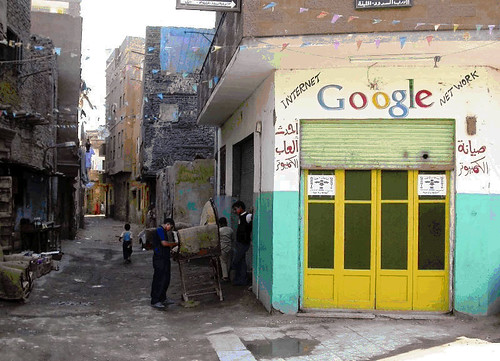
Early last month the mayor of Topeka, Kansas stunned the world by announcing that his city was changing its name to Google. We’ve been wondering ever since how best to honor that moving gesture. Today we are pleased to announce that as of 1AM (Central Daylight Time) April 1st, Google has officially changed our name to Topeka.


We didn’t reach this decision lightly; after all, we had a fair amount of brand equity tied up in our old name. But the more we surfed around (the former) Topeka’s municipal website, the more kinship we felt with this fine city at the edge of the Great Plains.

In fact, Topeka Google Mayor Bill Bunten expressed it best: “Don’t be fooled. Even Google recognizes that all roads lead to Kansas, not just yellow brick ones.”

For 150 years, its fortuitous location at the confluence of the Kansas River and the Oregon Trail has made the city formerly known as Topeka a key jumping-off point to the new world of the West, just as for 150 months the company formerly known as Google has been a key jumping-off point to the new world of the web. When in 1858 a crucial bridge built across the Kansas River was destroyed by flooding mere months later, it was promptly rebuilt — and we too are accustomed to releasing 2.0 versions of software after stormy feedback on our ‘beta’ releases. And just as the town's nickname is "Top City," and the word “topeka” itself derives from a term used by the Kansa and Ioway tribes to refer to “a good place to dig for potatoes,” we’d like to think that our website is one of the web's top places to dig for information.

In the early 20th century, the former Topeka enjoyed a remarkable run of political prominence, gracing the nation with Margaret Hill McCarter, the first woman to address a national political convention (1920, Republican); Charles Curtis, the only Native American ever to serve as vice president (’29 to ‘33, under Herbert Hoover); Carrie Nation, leader of the old temperance movement (and wielder of American history’s most famous hatchet); and, most important, Alfred E. Neuman, arguably the most influential figure to an entire generation of Americans. We couldn’t be happier to add our own chapter to this storied history.

A change this dramatic won’t happen without consequences, perhaps even some disruptions. Here are a few of the thorny issues that we hope everyone in the broader Topeka community will bear in mind as we begin one of the most important transitions in our company’s history:
  • Correspondence to both our corporate headquarters and offices around the world should now be addressed to Topeka Inc., but otherwise can be addressed normally.
  • Google employees once known as “Googlers” should now be referred to as either “Topekers” or “Topekans,” depending on the result of a board meeting that’s ongoing at this hour. Whatever the outcome, the conclusion is clear: we aren’t in Google anymore.
  • Our new product names will take some getting used to. For instance, we’ll have to assure users of Topeka News and Topeka Maps that these services will continue to offer news and local information from across the globe. Topeka Talk, similarly, is an instant messaging product, not, say, a folksy midwestern morning show. And Project Virgle, our co-venture with Richard Branson and Virgin to launch the first permanent human colony on Mars, will henceforth be known as Project Vireka.
  • We don’t really know what to tell Oliver Google Kai’s parents, except that, if you ask us, Oliver Topeka Kai would be a charming name for their little boy.
  • As our lawyers remind us, branded product names can achieve such popularity as to risk losing their trademark status (see cellophane, zippers, trampolines, et al). So we hope all of you will do your best to remember our new name’s proper usage:
Finally, we want to be clear that this initiative is a one-shot deal that will have no bearing on which municipalities are chosen to participate in our experimental ultra-high-speed broadband project, to which Google, Kansas has been just one of many communities to apply.